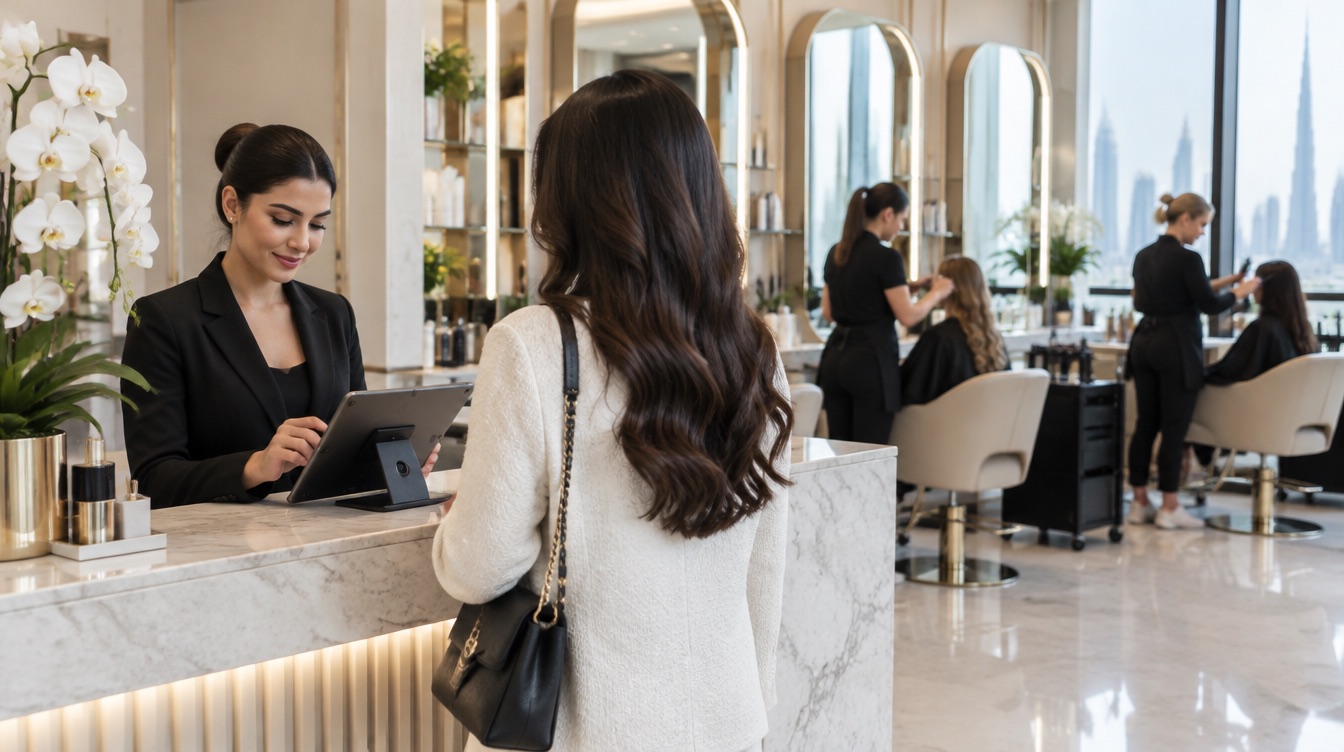
Salon POS system in the UAE: calendar, checkout and pay
One calendar for every stylist and room, appointments that become tickets, commissions and tips calculated: choosing a salon POS system in the UAE.
A salon POS system in the UAE links the appointment calendar to checkout, so each booking becomes a ticket with its service, specialist, products and tip. It also calculates each specialist's commission and keeps client profiles, packages and loyalty in one place.
Key takeaways
- A salon POS system in the UAE links the appointment calendar to checkout: the service and the specialist carry over to the ticket, with nothing to retype.
- One calendar for every stylist, therapist and room, fed by online, phone and front-desk bookings, is what stops double bookings.
- Commissions and tips should be calculated at checkout, per specialist, so the end of the month is a report, not an argument.
- Client profiles, packages, gift cards and loyalty turn first visits into regular bookings.
- Test the system on a real busy day: a late client, a walk-in, a product sale and a tip on the same ticket.
What a salon POS system in the UAE does that a plain till does not
A salon does not sell items off a shelf. It sells the time of a specific person, in a specific chair or room, at a specific hour. That is why a plain cash register is never enough for a hair salon, a barbershop, a nail bar or a beauty institute in Dubai, Abu Dhabi or Sharjah.
A salon POS system connects three things that usually live apart: the appointment book, the checkout and the team's pay. When they are separate, the same information is written three times, in a diary, on a receipt and in a spreadsheet at the end of the month. Each copy is a chance to make a mistake.
In the UAE, salons often have teams from several countries and clients who book on their phone at any hour. Some clients are regulars who expect you to remember their colour formula. Others are visitors who found you online that morning. Your salon POS system should handle both without making the front desk work harder.
In practice, a good system covers:
- The calendar: every specialist and every room, with bookings from every channel in one place.
- Checkout: the appointment becomes a ticket, with retail products and a tip added before payment.
- Commissions and tips: each specialist's share calculated automatically.
- Clients and loyalty: profiles, packages, memberships, gift cards and rewards.
- Reports: daily and monthly revenue, appointments and no-shows.
A salon does not sell items off a shelf. It sells the time of a specific person.
One calendar for every stylist, therapist and room
Double bookings happen when bookings arrive from several places and land in several places. A client books on the phone, another walks in, a third messages the salon, and the diary at the front desk no longer matches what each stylist thinks their afternoon looks like.
The fix is one calendar with a column for each specialist and each room. Online, phone and front-desk bookings all land there in real time. Each specialist sees their own day, and the manager sees everyone. When a client is running late, you drag the appointment to another time or to another colleague in one gesture, and the client can be notified.
Rooms matter as much as people. A spa or beauty institute may have one massage room and two facial cabins. If the calendar only knows about staff, two therapists can be booked into the same room at the same time. A salon POS system should treat rooms as resources with their own calendar.
Staff schedules complete the picture. When team rotas are matched to the booking calendar, you can see on Wednesday that Saturday has twenty-two appointments for three specialists, and adjust before the day arrives rather than during it.
With inyad POS, clients can also book online from a page in your salon's name, open day and night, with automatic reminders and online deposits. Those bookings land straight in the same calendar. This comes from the online appointment booking tool on the same account.
From appointment to receipt in one tap
At the end of the visit, the system already knows which service was done, by whom and at what price. The appointment becomes a ticket in one tap. The front desk only adds what changed: a hair treatment the client decided to buy, a tip, perhaps a second service added during the visit.
Retail products deserve attention. Shampoos, serums and accessories are often a real share of a salon's revenue. In a good salon POS system they are scanned and added to the same ticket as the service, and the stock goes down. You know which products sell, and which specialist recommends them.
Payment should accept bank cards, cash and digital wallets at the counter. Tips can be a percentage or a custom amount chosen by the client. Afterwards, the receipt goes out by WhatsApp, SMS or email, so the client keeps a record without a paper slip.
The test is simple. Ask the vendor to run this live: a client comes out of a colour appointment, buys a product, adds a tip and pays half by card and half in cash. If the demo needs workarounds, the front desk will need them every day.
With inyad POS, the service and the specialist come from the calendar to the ticket: add a product or a tip, and take payment.
Discover inyad POS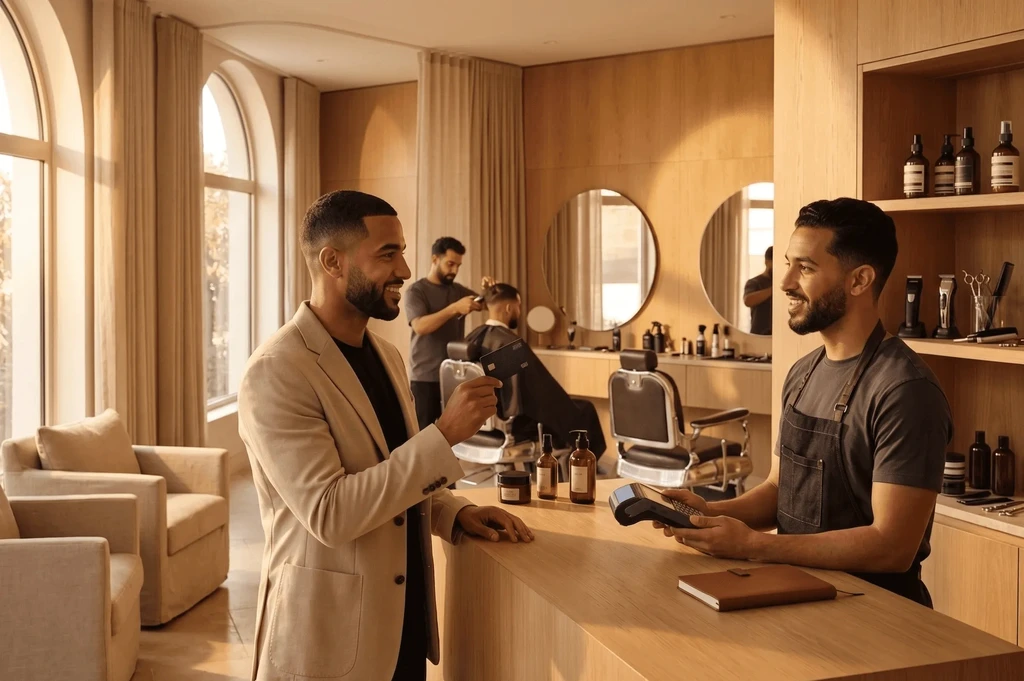
Commissions and tips: everyone's share, calculated
In many salons, the end of the month means a notebook, a calculator and a conversation nobody enjoys. Who did which service? Was the product sold by the stylist or the receptionist? Where did that tip go?
A salon POS system removes the guesswork. You assign each specialist a commission as a percentage or a fixed amount. At checkout, the system records who performed the service and calculates their share. Tips are credited to the specialist who did the work. Products sold are deducted from stock and counted in each person's sales.
The result is a daily view per specialist: number of services, revenue, commission and tips. Each person can see their own numbers. You see everyone's. Gaps between the calendar and the till disappear, because every ticket is linked to an appointment and a person.
This also helps you manage the team. If one stylist is fully booked every Thursday and another has gaps, the numbers show it. If no-shows cluster on certain days, the reports show that too, and you can ask for deposits on those slots.
Clients, packages and loyalty
A client who feels recognised comes back sooner. Every visit should enrich the client profile: services received, preferences, notes such as a colour formula or an allergy, and products bought. The next time they book, whoever is on shift can read the notes before the client sits down.
Packages and memberships keep clients returning on a rhythm. A course of ten blow-dries, a monthly membership or a set of massage sessions should be deducted automatically at each visit, so nobody has to check a paper card.
Gift cards are useful in the UAE, where clients often buy treatments as presents. They should be sold at the counter and redeemed at the next appointment, with the balance tracked in the system.
A loyalty program rewards the clients who rebook. Keep it simple: a reward that clients understand in one sentence works better than a points system that needs explaining.
Example: a Thursday evening in a Dubai beauty salon
This example is illustrative. Rania runs a beauty salon in Dubai with four specialists and two treatment rooms.
- Morning: Rania opens the calendar on her phone. Thursday evening is almost full, with sixteen appointments between 17:00 and 21:00. Two came in overnight through the online booking page, with deposits.
- 17:20: a client is running late. The receptionist drags her manicure to 17:45 with another specialist, and the client is notified.
- 18:30: a facial ends. The appointment becomes a ticket, the therapist adds a hydrating serum the client wants, the client adds a tip and pays by card. The receipt goes by WhatsApp.
- 19:15: a regular uses the fifth session of her massage package. The system deducts it and shows three sessions left.
- 21:30: closing. The report shows revenue for the day, each specialist's services, commission and tips, and one no-show. Nobody needs a calculator.
Choosing a salon POS system in the UAE: mistakes to avoid
- Choosing a calendar without a till, or a till without a calendar: if they are separate tools, you will retype every appointment at checkout. Ask for both in one app.
- Forgetting rooms: if you have treatment rooms, check that they have their own calendar.
- Setting up commissions later: decide your commission rules before you start, and check that the system can apply them per specialist, as a percentage or a fixed amount.
- Ignoring the switch from paper: ask who sets up your services, specialists and prices, and whether the team is trained at the salon before the first busy day.
- Not asking about languages: with a multinational team, ask which languages the screens and the support team use.
- Skipping the offline question: ask what happens at checkout if the salon's internet drops on a Saturday afternoon.
With inyad POS, services, stylists, prices and bookings are configured with you at the salon, the team is trained on the screens, and help is one call or chat away every day of the week, with someone coming in person when it takes more than a call.
Frequently asked questions
Does a salon POS system replace my appointment book?
Yes, when the calendar and the POS are in the same app. Bookings from the phone, the front desk and online all land in one calendar, and at the end of each appointment the service and the specialist carry over to the ticket. Your paper diary becomes unnecessary within a few days.
How are commissions calculated in a salon POS system?
You set a commission for each specialist, as a percentage or a fixed amount. At checkout, the system records who performed the service and calculates their share. Tips are credited to that specialist, and the totals appear in daily and monthly reports.
Can I sell hair and beauty products on the same ticket as a service?
Yes. Retail products are scanned and added to the same ticket as the service, and the stock is updated. The sale is also counted in the specialist's figures, which helps when products are part of how you reward your team.
Is a salon POS system useful for a small salon in the UAE?
Yes, often more than for a large one. In a small salon, the owner usually works on clients and runs the front desk at the same time. A shared calendar, one-tap checkout and automatic commissions save the time that would otherwise go into the diary and the end-of-month calculations.
Was this article helpful? Share on WhatsApp Send by email
Your calendar and your till, together
inyad POS turns every appointment into a ticket, adds products and tips, sends the receipt by WhatsApp, SMS or email and calculates each specialist's commission.
Fast modifiers at the counter, orders taken at the table, stock down to beans and milk, and a till that matches every shift: choosing a café POS in Dubai.
9 min Free POS system in the UAE: what to know firstFree plans, trials, downloads and cracked copies: what a free POS really costs a UAE business, and how to start free without regretting it.
10 min POS machine in the UAE: which type fits your counter?Classic cash register, all-in-one touchscreen, tablet or phone, handheld card terminal: what each POS machine does well, and how to pick yours.
7 min