E-invoicing in Egypt: the complete guide for businesses
The ETA system, the B2B and B2G mandate, e-receipts in phases, the four steps to join, VAT at 14 % and the simplified tax regime, in plain words.
As of October 2026, e-invoicing in Egypt is fully in force for sales to businesses and government: every tax invoice is signed and sent to the Egyptian Tax Authority system. Sales to consumers are covered by e-receipts, rolled out in phases.
Key takeaways
- As of October 2026, Egypt e-invoicing is fully in force for sales between businesses (B2B) and sales to government (B2G): every tax invoice goes through the Egyptian Tax Authority (ETA) system.
- Since December 2022, government entities may not contract with or pay companies that do not issue electronic tax invoices.
- Sales to consumers (B2C) are covered by the e-receipt, which the ETA rolls out in successive phases. Check whether your business is in a published phase.
- To join, you need four things: an account on the ETA e-invoicing portal, an electronic signature, a code for every item you sell, and invoicing software connected to the system.
- The standard VAT rate is 14 %. Joining e-invoicing and e-receipts is also a condition to benefit from the simplified tax regime under Law No. 6 of 2025.
What Egypt e-invoicing means for your business
An electronic invoice in Egypt is not a PDF sent by email. It is a structured file, signed electronically, that your invoicing software sends to the Egyptian Tax Authority. The ETA checks it, gives it a unique identifier, and records it. Your customer then sees the same validated invoice on their side.
In practice, this changes three things for a business owner:
- The tax authority sees every invoice in real time: there is no gap between what you invoice and what you declare. Your VAT return and your sales records must tell the same story.
- Your customers depend on it: a business buyer can only rely on an invoice that exists in the ETA system. A paper invoice, or a PDF that was never submitted, is a problem for them, and they will ask you for a valid one.
- Your item list must be clean: every product or service on an invoice carries a code. A messy catalogue becomes a daily obstacle.
The system the ETA uses is called the e-invoicing system (in Arabic, منظومة الفاتورة الإلكترونية). It is the same platform for small and large companies. What changes from one business to another is how you connect to it: through an ERP, through invoicing software, or through a service provider.
If you issue tax invoices to businesses in Egypt, e-invoicing is not a project for later. It applies now.
Where the Egypt e-invoicing mandate stands in October 2026
As of October 2026, here is the situation. Rules can change, so always check the latest ETA decisions before you act.
- B2B invoices: e-invoicing was rolled out in phases from 2020 to 2023. Companies were added group by group, starting with the largest taxpayers. Today the obligation is fully in force for businesses that issue tax invoices to other businesses.
- B2G invoices: since December 2022, government entities may not contract with or pay companies that do not issue electronic tax invoices. If you sell to a ministry, a public authority or a state company, e-invoicing is the condition to get paid.
- B2C sales: sales to individual consumers are covered by the e-receipt, a separate system rolled out in phases named by ETA decisions. Printed e-receipts now carry a QR code that links to the validated record.
Two points are worth repeating. First, the mandate is not a project for later: if you issue tax invoices to businesses in Egypt, it applies now. Second, a business that sells both to companies and to consumers usually deals with both systems, the e-invoice for its B2B sales and the e-receipt for its counter sales, once its phase is published.
In inyad Invoicing, a quote becomes an invoice in one click, and a credit note is raised against the original invoice, so your history stays clean.
Discover inyad Invoicing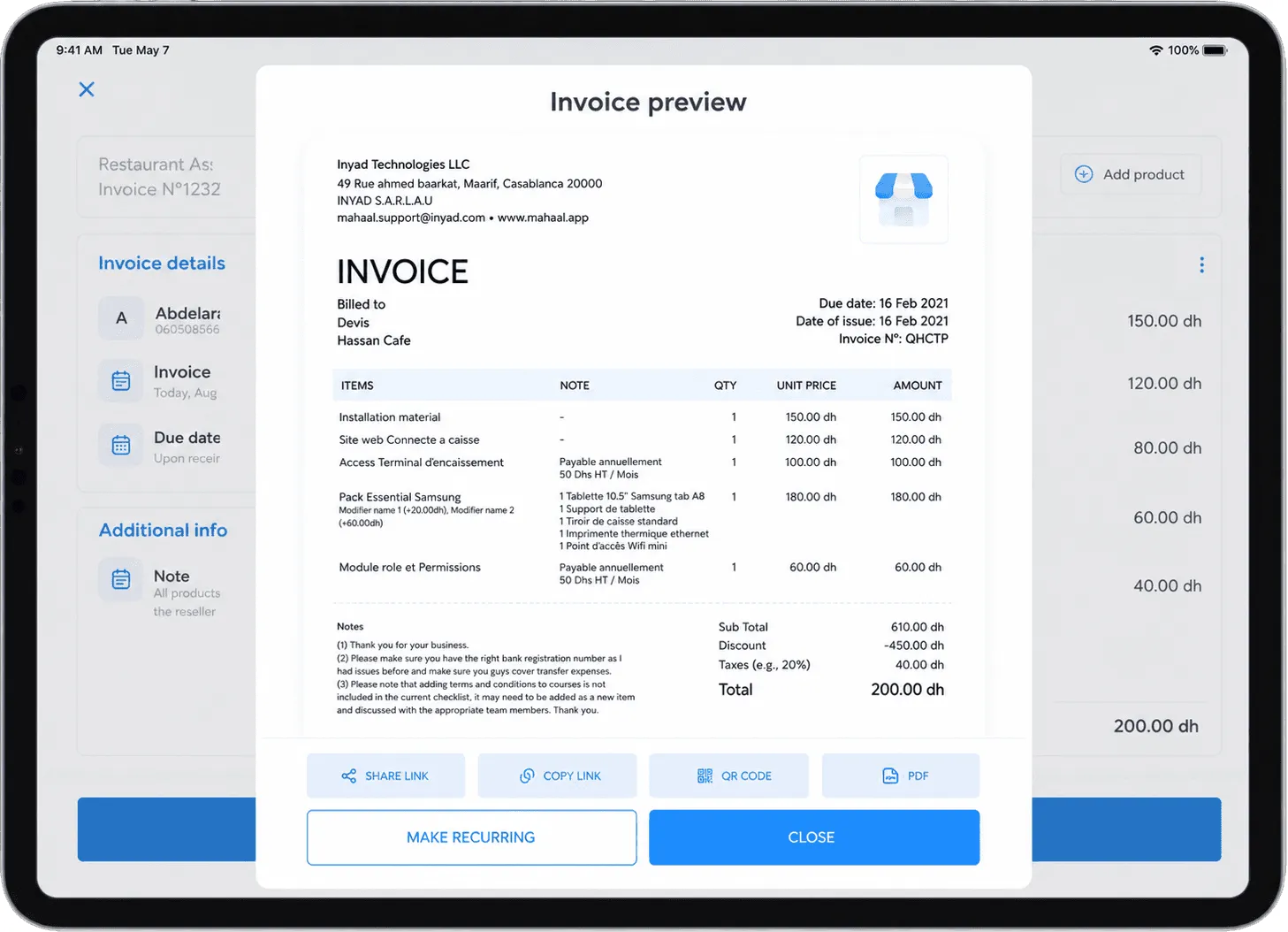
The four requirements to join Egypt e-invoicing
Joining the ETA system follows the same path for every business. Plan each step, because the last one depends on the first three.
1. Register on the ETA e-invoicing portal
Registration is linked to your tax registration number. You declare the company, its activity and the people authorised to act for it. Make sure your tax file is up to date before you start: a wrong address or an old activity code slows everything down.
2. Get an electronic signature
Every e-invoice is signed. You can use a USB token issued to a named signatory, usually the owner or a manager, or an electronic seal for the company. Both come from a licensed certification provider. Think about who will sign: if the only token belongs to someone who travels a lot, invoicing stops when they are away.
3. Code every item you sell
Each line on an invoice needs an item code. Products with a barcode use their GS1 code. For everything else, including services, you create an EGS code, built on the international GPC classification. This step takes longer than most owners expect. Start with your best sellers, then work through the rest of the catalogue.
4. Connect your invoicing software
Finally, your invoicing solution must send invoices to the ETA. Larger companies connect their ERP through the ETA's SDK and API. Smaller businesses usually rely on invoicing software that already handles the connection. Once connected, you issue signed invoices, and each one comes back with its ETA validation.
VAT on an e-invoice in Egypt
The standard VAT rate in Egypt is 14 %. On an e-invoice, VAT is shown line by line, with the tax type and rate that apply to each item, and the totals are calculated from those lines. That is why item codes and tax settings must be right from the start: a wrong rate on one product repeats itself on every invoice.
A simple example in Egyptian pounds: you sell a service for EGP 10,000 before tax. VAT at 14 % is EGP 1,400, and the invoice total is EGP 11,400. Your customer can only use that VAT if the invoice exists in the ETA system.
VAT registration depends on your annual revenue. The threshold has long been EGP 500,000, and some sources report that it was lowered to EGP 250,000 in 2026. Check the current threshold with the ETA, or with your accountant, before deciding whether you must register.
When an invoice is wrong, do not delete it or issue a new one with the same number. Correct it with a credit note or a debit note linked to the original invoice. Your records stay complete, and the history matches what the ETA holds.
E-invoicing and the simplified tax regime
Law No. 6 of 2025 created a simplified tax regime for small projects. Businesses with annual turnover up to EGP 20 million may opt in. Instead of the usual income tax calculation, they pay a percentage of turnover, set by band: from 0.4 % for turnover under EGP 500,000, up to 1.5 % for turnover between EGP 10 million and EGP 20 million. Check the full table of bands with the ETA or your accountant.
The point that matters here: joining the e-invoice and e-receipt systems is a condition to benefit from the regime. For a small business, e-invoicing is therefore not only an obligation. It is also what opens the door to a simpler tax calculation.
If you are considering the simplified regime, treat e-invoicing as the first step, not the last. Register, get your signature, code your items and connect your software, then apply with your house in order.
How to get ready: a practical checklist
Whether you are joining for the first time or cleaning up a setup that works badly, the same order of work applies.
- Check your tax file: tax registration number, address, activity, authorised people. Fix anything outdated first.
- Choose who signs: decide between a named signatory token and a company e-seal, and plan a backup so invoicing never depends on one person.
- Clean your catalogue: one name, one price, one tax rate and one code per item. Remove duplicates before you code anything.
- Pick your invoicing tool: ask clearly whether it connects to the ETA e-invoicing system, how invoices are signed, and how you see the validation status of each invoice.
- Test with real cases: an ordinary invoice, an invoice with several tax rates, a credit note. Make sure each one is accepted.
- Train the people who invoice: they need to know what to do when an invoice is rejected, and never to fix a mistake by editing a sent invoice.
- Keep an eye on ETA decisions: especially for e-receipts, where new phases are announced over time.
inyad Invoicing connects to the Egyptian Tax Authority's e-invoicing system. You create quotes and turn them into invoices in one click, numbering is automatic, credit notes are linked to the original invoice, and every document is stored and easy to find. You can also send invoices with a payment link on WhatsApp, SMS or email, so customers pay from the invoice itself.
Frequently asked questions
Is e-invoicing mandatory for all businesses in Egypt?
As of October 2026, e-invoicing is fully in force for businesses that issue tax invoices to other businesses (B2B) and to government entities (B2G). Sales to consumers are covered by the e-receipt, which applies phase by phase. If you are not sure which rule covers you, check your situation with the ETA or your accountant.
What is the difference between an e-invoice and an e-receipt?
The e-invoice covers sales to businesses and government, with full buyer details and a tax registration number. The e-receipt covers sales to consumers at the point of sale, with a QR code on the printed receipt. They are two separate systems run by the Egyptian Tax Authority, and many businesses need both.
Can I issue e-invoices without an ERP?
Yes. Large companies often connect their ERP to the ETA, but smaller businesses usually use invoicing software that already handles the connection. What matters is that your tool sends signed invoices to the ETA system and shows you whether each one was accepted. inyad Invoicing is one option for small and medium businesses.
How much does it cost to join the ETA system?
The costs depend on your situation: the electronic signature from a licensed certification provider, your invoicing software, and the time needed to code your items. Ask each provider for its current terms in Egyptian pounds, and plan for the time your team will spend on setup.
Was this article helpful? Share on WhatsApp Send by email
Invoices that go through the ETA
inyad Invoicing connects to the Egyptian Tax Authority's e-invoicing system, turns quotes into invoices in one click, numbers and stores every document, and sends invoices with a payment link.