Egypt e-receipt: who must issue it and how it works
B2C e-receipts in Egypt: phases set by ETA decisions, how it works at the till, the QR code, the difference with the e-invoice and what to check.
The Egypt e-receipt is the electronic receipt for sales to consumers, sent to the Egyptian Tax Authority at the point of sale. As of October 2026, businesses must issue it once they fall into a phase published by an ETA decision.
Key takeaways
- The Egypt e-receipt is the electronic record of a sale to a consumer (B2C), issued at the point of sale and sent to the Egyptian Tax Authority (ETA).
- As of October 2026, e-receipts are rolled out in successive phases named by ETA decisions. Your obligation starts when your business falls into a published phase.
- Printed e-receipts carry a QR code that links to the validated record in the ETA system.
- The e-receipt is not the e-invoice: the e-invoice covers sales to businesses and government, the e-receipt covers sales to individuals.
- Before choosing a point of sale or e-receipt solution, check that it appears on the list published by the ETA.
The e-receipt does not replace good habits at the till. It makes them visible.
What is the Egypt e-receipt?
The Egypt e-receipt (in Arabic, الإيصال الإلكتروني) is the digital version of the receipt you give a customer after a sale. When a shop, a restaurant, a pharmacy or a salon sells to an individual, the point of sale system creates the receipt, sends it to the Egyptian Tax Authority, and gets it validated. The customer receives a printed or digital receipt that matches the record held by the ETA.
The goal is simple: give the tax authority a view of consumer sales comparable to what e-invoicing already gives for sales between businesses. For the business owner, it means every counter sale leaves a trace that can be checked, and that the till, the stock and the tax return must agree.
The e-receipt does not replace good habits at the till. It makes them visible. A cash sale that was never rung up, a discount typed by hand, a refund paid from the drawer without a record: all of these now show up as gaps between your sales and your receipts.
Who must issue the Egypt e-receipt, and when
As of October 2026, the ETA does not apply the e-receipt to every business on the same day. It rolls the system out in successive phases, each one named by an ETA decision that lists which taxpayers must join and by when. Rules can change, so treat the following as a guide, not as legal advice.
- Businesses in a published phase: if your company is named, directly or by category, in an ETA decision, you must join the e-receipt system by the date that decision sets.
- Businesses not yet in a phase: you are not obliged yet, but you will be. Use the time to prepare your point of sale, your catalogue and your team.
- Businesses choosing the simplified tax regime: under Law No. 6 of 2025, joining the e-invoice and e-receipt systems is a condition to benefit from the regime. For a small business considering it, the e-receipt becomes relevant sooner.
How do you know where you stand? Check the ETA decisions and announcements, ask your accountant, and keep an eye on any notification sent to your tax account. Do not rely on a supplier telling you that you are "not concerned": the decision that matters is the ETA's.
How the Egypt e-receipt works at the till
From the customer's side, almost nothing changes: they pay and receive a receipt. Behind the counter, the process follows a few steps.
- The sale is recorded: the cashier rings up the items on a point of sale system linked to the ETA e-receipt system.
- The receipt is sent: the system sends the receipt data to the Egyptian Tax Authority.
- The ETA validates it: each receipt gets its record in the system.
- The customer gets the receipt: printed or digital. A printed e-receipt carries a QR code that links to the validated record.
Each item on the receipt must be identified correctly, with the right price and the right tax. That is why the catalogue matters as much for e-receipts as for e-invoices: one product entered twice with two prices is a problem you will see every day.
Plan for the moments when things do not go smoothly. What happens when the internet connection drops during a busy hour? How are refunds and exchanges recorded? Who can cancel a sale? Ask your point of sale provider these questions before you sign, not after the first busy weekend.
The QR code on printed e-receipts
As of 2026, printed e-receipts carry a QR code. When someone scans it, it leads to the record of that receipt in the ETA system. It does three useful things:
- For the customer: a simple way to check that the receipt is real and was declared.
- For the tax authority: a fast check during an inspection, without going through your files.
- For you: proof that each sale was sent and validated, which protects you if a receipt is questioned later.
In practice, check that your printer and your receipt layout print the QR code clearly, at a size a phone can read. A faded or cut-off code defeats its own purpose.
inyad Invoicing lists every invoice you sent to companies, with what is paid, pending or overdue, so B2B sales never get mixed with counter receipts.
Discover inyad Invoicing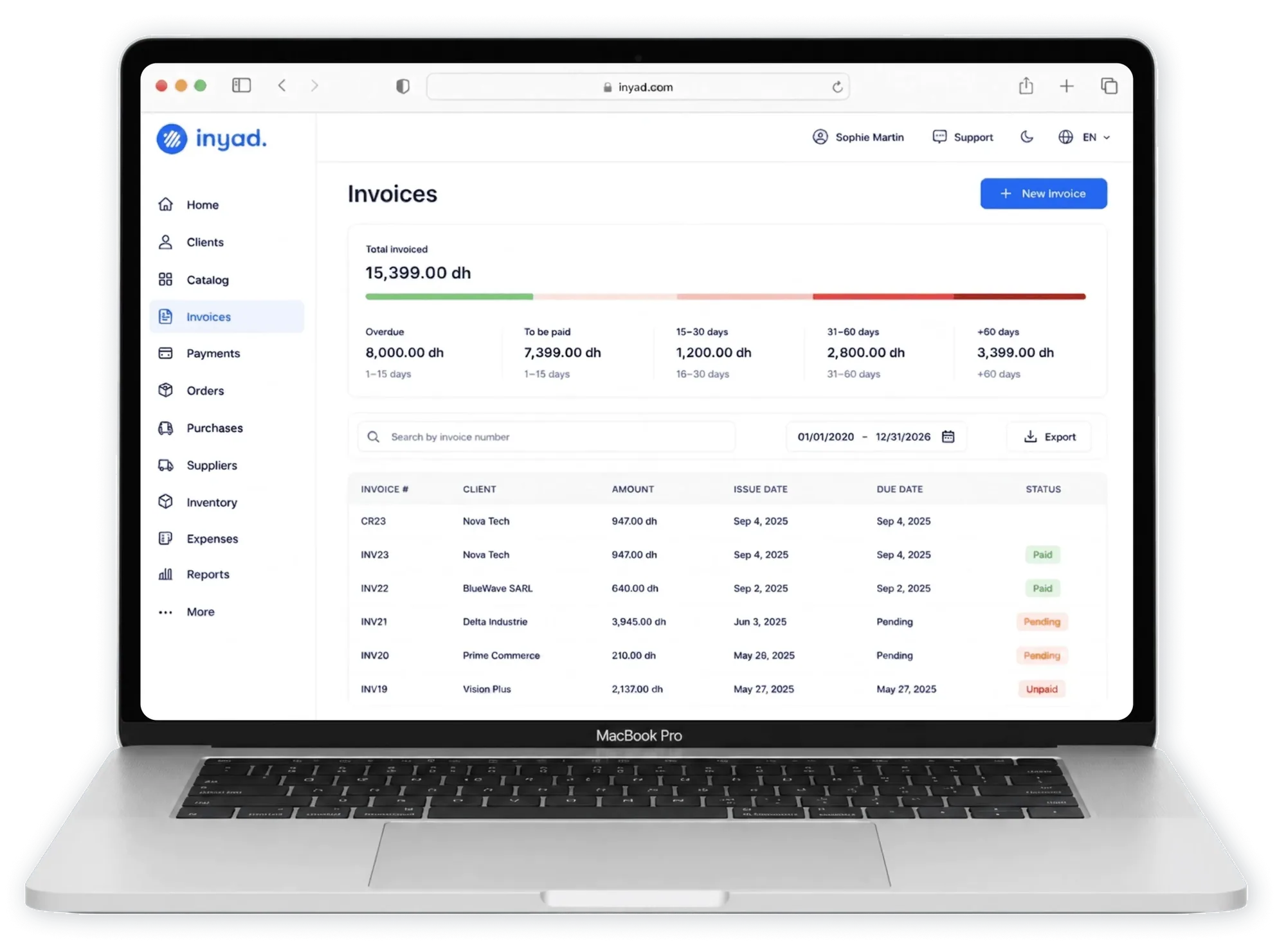
E-receipt or e-invoice: what is the difference in Egypt?
Both are run by the Egyptian Tax Authority, and both are electronic records sent in real time. But they cover different sales and work differently.
- Who the buyer is: the e-invoice is for sales to businesses (B2B) and government (B2G). The e-receipt is for sales to individual consumers (B2C).
- Buyer details: an e-invoice carries the buyer's full details, including their tax registration number. An e-receipt usually does not identify the buyer.
- Where it is issued: e-invoices come from invoicing software or an ERP. E-receipts come from a point of sale system at the counter.
- Status in October 2026: e-invoicing for B2B and B2G is fully in force. E-receipts are being rolled out in phases named by ETA decisions.
- What the customer does with it: a business buyer relies on the e-invoice for its own accounts and VAT. A consumer keeps the e-receipt as proof of purchase.
Many businesses need both. A wholesaler who also sells at the counter, a restaurant that caters for companies, a print shop with walk-in customers and corporate clients: each one issues e-invoices to companies and e-receipts to individuals. The two flows must not be mixed. A company that asks for an invoice needs an e-invoice with its details, not an e-receipt.
For B2B sales, inyad Invoicing connects to the Egyptian Tax Authority's e-invoicing system, so your invoices to companies go through the ETA. For e-receipts at the till, check your point of sale or e-receipt solution against the list published by the ETA.
What to check before your e-receipt phase starts
Whether your phase is already published or still to come, the same checklist helps you avoid last-minute stress.
- Your phase: read the ETA decisions and confirm whether and when your business must join.
- Your tax file: tax registration number, address, branches and activity must be up to date.
- Your point of sale solution: make sure it appears on the list published by the ETA, and ask how it handles connection cuts, refunds and the QR code.
- Your catalogue: one name, one price, one tax rate per item. Remove duplicates before going live.
- Your hardware: printers able to print a clear QR code, and enough devices for busy hours.
- Your team: cashiers who know how to record a refund, an exchange or a cancelled sale properly.
- Your B2B sales: if you also sell to companies, make sure those sales go out as e-invoices, not receipts. inyad Invoicing handles that side, with quotes, automatic numbering, credit notes and sending on WhatsApp, SMS or email.
The standard VAT rate in Egypt is 14 %, and it applies to consumer sales as well as business sales unless a specific rule says otherwise. Check with your accountant how VAT should appear on your receipts, especially if you sell items with different tax treatments.
Frequently asked questions
Is the e-receipt mandatory for every shop in Egypt?
Not all at once. As of October 2026, the Egyptian Tax Authority adds businesses in successive phases, each set by an ETA decision. Your obligation starts when your business falls into a published phase. Check the latest decisions, and remember that joining is also a condition for the simplified tax regime.
Can I give a customer an e-invoice instead of an e-receipt?
If the customer is a business that asks for an invoice with its tax registration number, it needs an e-invoice. If the customer is an individual, the sale is covered by the e-receipt once your phase applies. Keep the two flows separate so your records stay clear.
What does the QR code on an e-receipt show?
The QR code on a printed e-receipt links to the validated record of that receipt in the ETA system. Anyone who scans it can check that the receipt exists and was declared. Make sure your printer prints it clearly enough for a phone to read.
How do I choose an e-receipt solution?
Start with the list of solutions published by the Egyptian Tax Authority, then compare how each one handles your daily reality: busy hours, connection cuts, refunds, several tills or branches. Ask for a demonstration with your own products before you decide.
Was this article helpful? Share on WhatsApp Send by email
Your B2B invoices, sent to the ETA
For your sales to companies, inyad Invoicing connects to the Egyptian Tax Authority's e-invoicing system, numbers every invoice, links credit notes to the original and sends invoices on WhatsApp, SMS or email.