
Accredited Service Providers (ASP) for UAE e-invoicing
Every UAE business will send e-invoices through an Accredited Service Provider. What it does, how to choose one, and when you must have appointed it.
For UAE e-invoicing, an Accredited Service Provider (ASP) connects your business to the Peppol network and carries your invoices. As of October 2026, large businesses must appoint one by 30 October 2026 and others by 31 March 2027.
Key takeaways
Under UAE e-invoicing, no business sends its invoices alone. Each one goes through an accredited service provider, and choosing it well saves months. As of October 2026:
- An Accredited Service Provider (ASP) is a company accredited in the UAE to connect businesses to the Peppol e-invoicing network.
- You need one: there is no government portal to upload invoices to. Your ASP sends and receives them for you.
- Deadlines: businesses with revenue of AED 50 million or more appoint an ASP by 30 October 2026; smaller businesses and government entities by 31 March 2027.
- Choose on fit, not on a logo: how the ASP connects to your invoicing software matters more than anything else.
- Check the official list: accreditation is granted by the authorities, so confirm any provider on the Ministry of Finance or Federal Tax Authority (FTA) websites.
What an accredited service provider does in UAE e-invoicing
The UAE chose a decentralised model, built on Peppol, an international network for exchanging business documents. Businesses do not connect to it directly. They go through access points, and in the UAE those access points are Accredited Service Providers.
In practice, your ASP does four jobs:
- Receives your invoice from your invoicing or accounting software.
- Checks it against the UAE format, PINT AE: required fields present, TRNs and amounts in the right shape.
- Delivers it to your customer's ASP on the Peppol network, which hands it to your customer.
- Passes the tax data to the FTA, so the authority sees the invoice without you filing it separately.
It also works the other way: when a supplier sends you an invoice, it arrives through your ASP. One provider covers both what you send and what you receive.
Think of your ASP as your post office on the network. You write the letter in your own software; the ASP checks the address and stamp, and makes sure it arrives.
Why every UAE business needs an ASP
Once e-invoicing applies to you, an invoice only counts if it is issued in the PINT AE format and sent through an ASP. A PDF attached to an email, however complete, will not meet the rule on its own.
That makes the ASP a requirement, not an option. The Ministry of Finance has also made the appointment a dated step in its own right, ahead of the go-live date. Cabinet Decision No. 106 of 2025 sets administrative penalties for e-invoicing non-compliance (voluntary participants are exempt). Amounts quoted vary between sources; check the decision itself or ask your tax adviser.
There is a practical upside too. Because the ASP checks each invoice before it leaves, errors such as a missing TRN or a wrong VAT total are caught at the moment you send, not months later in an audit or a dispute with a customer.
What the ASP does not change is your responsibility for the content of the invoice. The rules on what a tax invoice shows still apply: the words "Tax Invoice", your name, address and TRN, your customer's details where they are registered, a sequential number, the dates and the VAT, at 5 % as standard. The ASP carries and checks the invoice; you remain the one who issues it.
ASP appointment deadlines
As of October 2026, the Ministry of Finance has set these dates. Each group has an appointment deadline and, a few months later, a go-live date.
- Revenue of AED 50 million or more: appoint an ASP by 30 October 2026 (extended from 31 July 2026), mandatory e-invoicing from 1 January 2027.
- Revenue below AED 50 million: appoint an ASP by 31 March 2027, mandatory from 1 July 2027.
- Government entities: appoint an ASP by 31 March 2027, mandatory from 1 October 2027.
- Voluntary pilot: open since 1 July 2026 for any business that wants to start early.
The first deadline has already moved once, so confirm your dates on the Ministry of Finance and FTA websites. And note the gap between appointment and go-live: it exists so you can connect your systems and test before invoices must go through the network.
If you are a large business reading this in late October 2026 without a provider, focus on the appointment first and the integration second. They are separate steps, and the appointment is the one with the nearer date. If you are a smaller business, use the months before March 2027 to compare providers calmly instead of signing with whoever still has capacity in the last week.
The best ASP for a small business is often the one already built into the software it invoices with.
How to choose an Accredited Service Provider in the UAE
Several providers are accredited, and more may join. We do not recommend or rank any of them here. Instead, use these criteria to compare the ones you are considering.
The criteria that matter
- Accreditation: the provider appears on the official list published by the authorities. Check it yourself rather than relying on a sales deck.
- Fit with your software: does the ASP connect to the invoicing or accounting tool you already use? If not, who builds the connection, and who pays for it?
- Sending and receiving: you need both. Confirm that incoming supplier invoices land somewhere useful, not in a separate inbox nobody checks.
- Error handling: when an invoice is rejected, how will you know, and how clearly is the reason explained?
- Corrections: how credit notes are sent and linked to the original invoice.
- Storage and access: where your invoices are kept, how long, and whether you can search and export them.
- Support: in which languages, at what hours, and whether a person answers during your go-live week.
- Pricing model: per invoice, per month or bundled with software. Estimate your yearly volume before comparing.
- Exit: how you take your data with you if you change provider later.
Two ways to work with an ASP
- Directly: you sign with an ASP and connect your own systems to it. This suits large businesses with an ERP and an IT team.
- Through your invoicing software: your software works with an ASP, and you keep invoicing in the tool you know. This suits most small and medium businesses, because there is one product, one login and one support line.
Red flags
- A promise that nothing changes: your customer data still needs correct TRNs and legal names, whatever the provider says.
- No test period: a provider that cannot let you send real test invoices before go-live leaves you to discover problems on day one.
- Receiving as an afterthought: if incoming invoices are an extra product or a separate login, ask why.
- Unclear pricing: if you cannot estimate your yearly cost after one call, expect surprises.
In inyad Invoicing, invoices and credit notes sit in one numbered list, with paid, pending and overdue amounts in view.
Discover inyad Invoicing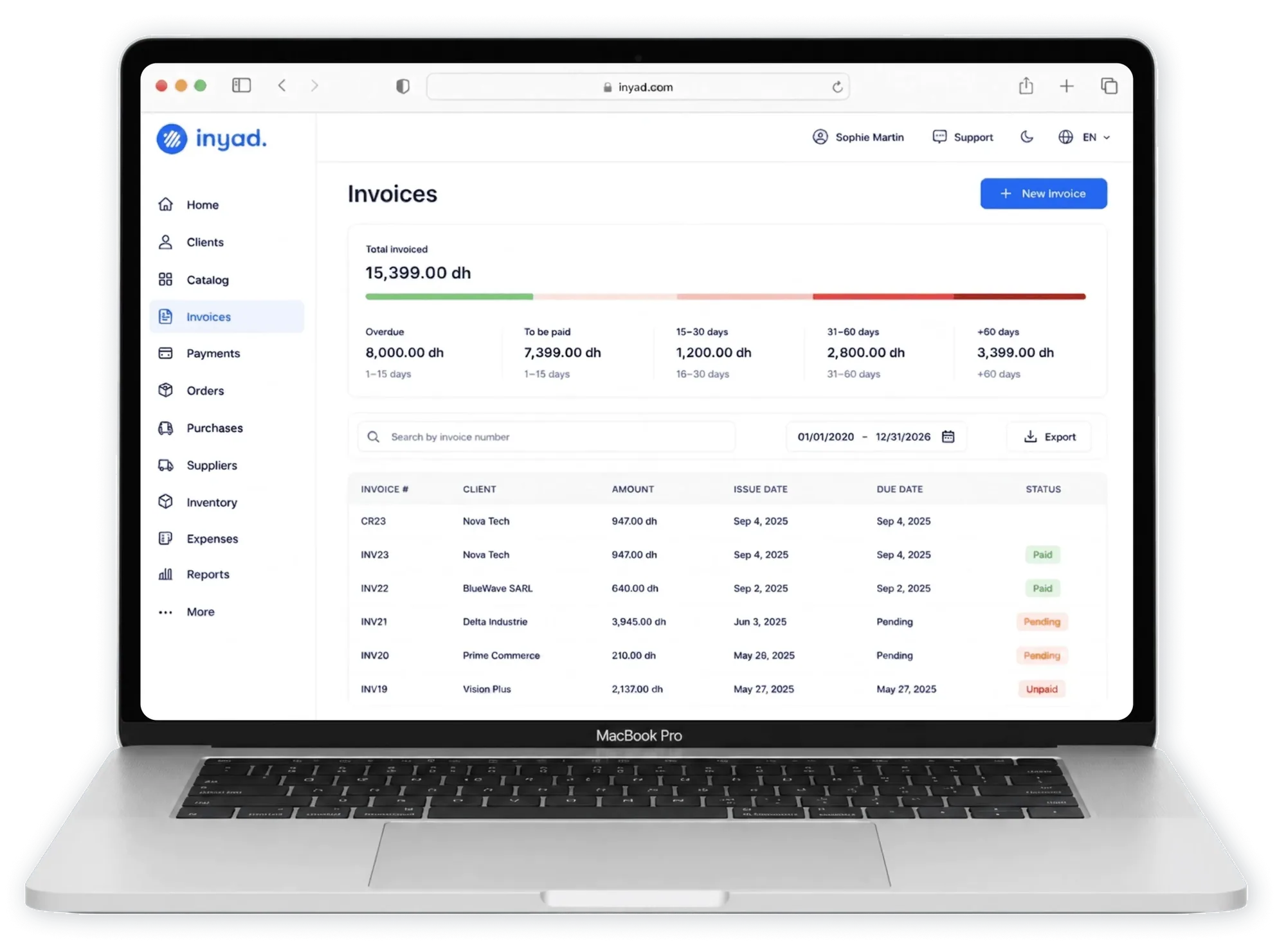
Questions to ask before you sign
A short call with each shortlisted provider, or with your software vendor, should answer these. Write the answers down so you can compare like for like.
- Can you show me your accreditation on the official list?
- How do you connect to the software I use today, and what do I need to change?
- Can I send test invoices to a real customer before my go-live date?
- What happens, step by step, when an invoice is rejected?
- How do I receive supplier invoices, and where do I see them?
- What will I pay in a typical year at my invoice volume?
- If I leave, in what format do I get my invoice history?
If an answer is vague, ask again. Clarity now is cheaper than confusion in your first week live.
How inyad works through an ASP
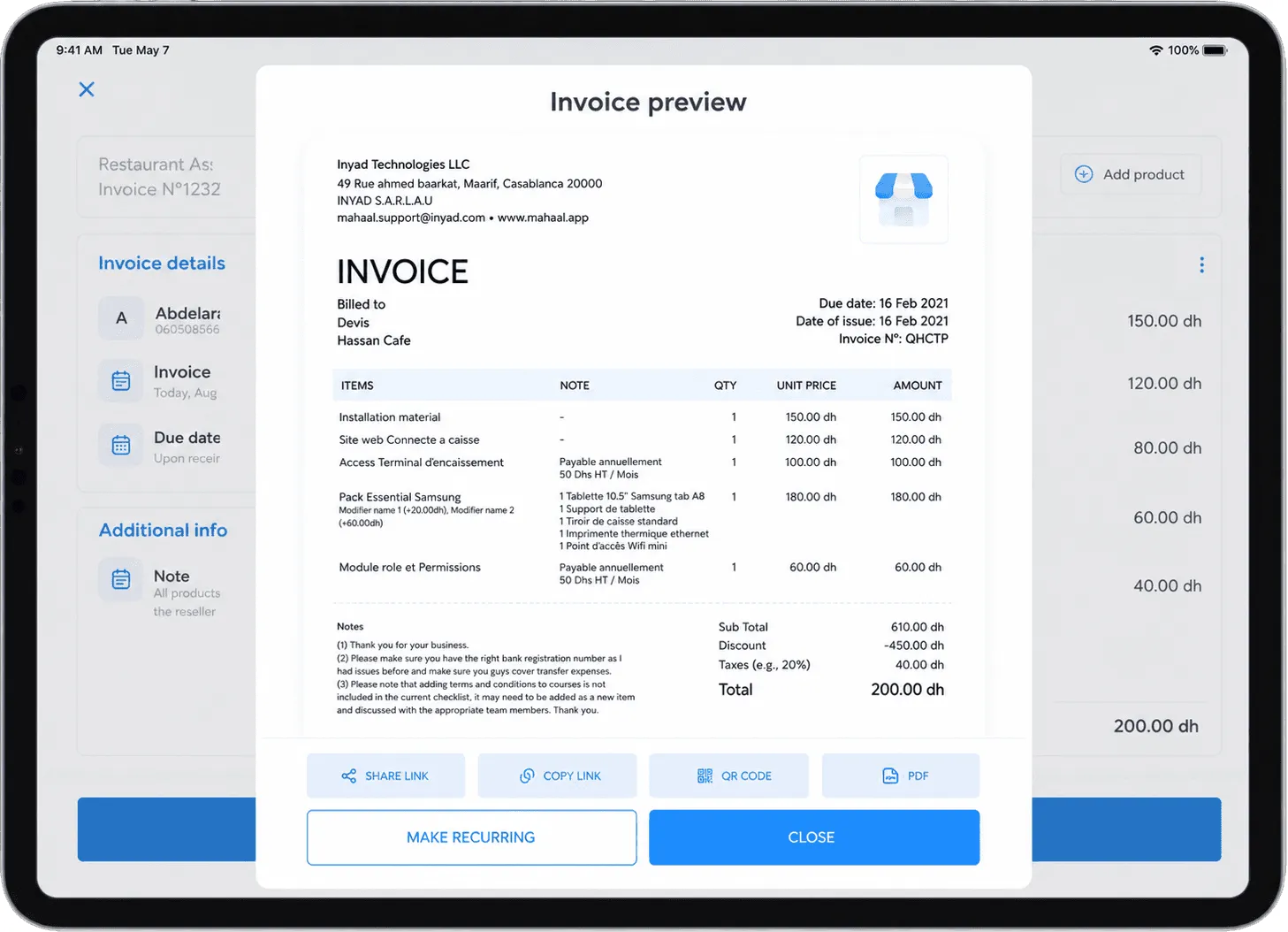
inyad Invoicing issues and receives e-invoices through an Accredited Service Provider on the UAE's Peppol network. That means you do not have to run a separate connection project: you keep working in inyad, and the network side happens when you send.
The daily work stays the same. You turn a quote into an invoice in one click, numbering runs automatically, corrections go out as credit notes against the original, and recurring invoices for retainers send themselves on schedule. Every document is stored and searchable, and you can share invoices on WhatsApp, SMS or email with a payment link inside, so customers can pay from the invoice itself.
Whichever route you choose, the test is the same: before your appointment deadline, you should know exactly how your next invoice will reach your customer through the network.
Frequently asked questions
Can I connect to the Peppol network myself, without an ASP?
No. In the UAE model, businesses send and receive e-invoices through an Accredited Service Provider. There is no direct connection for individual businesses and no government portal to upload invoices to.
Does my customer need to use the same ASP as me?
No. Peppol is built so that providers exchange invoices with each other. You use your ASP, your customer uses theirs, and the invoice travels between them.
Can I change ASP later?
In principle yes, as with any service provider, but check the exit terms before you sign: how your invoice history is handed back, and how long a switch takes.
Where do I find the list of accredited providers?
The authorities publish it. Check the Ministry of Finance and FTA websites for the current list, since providers can be added over time.
Was this article helpful? Share on WhatsApp Send by email
Your invoices, carried through an ASP
inyad Invoicing issues and receives e-invoices through an Accredited Service Provider on the UAE's Peppol network, with quotes, credit notes, recurring invoices and a payment link.
Peppol is the network, PINT AE is the UAE invoice format. What each means, how an invoice travels in five steps, and what is your job or your software's.
7 min Simplified tax invoice in the UAE: when you can use itThe AED 10,000 rule, what a simplified invoice must show compared with a full one, why your customer cares, and a checklist with examples in AED.
8 min Tax invoice template for the UAE: free model explainedA complete tax invoice model with optional Arabic labels, each field explained, a filled example in AED at 5 % VAT, and the limits of a template.
8 min