
Peppol and PINT AE: UAE e-invoicing explained simply
Peppol is the network, PINT AE is the UAE invoice format. What each means, how an invoice travels in five steps, and what is your job or your software's.
In the UAE, Peppol is the network e-invoices travel on and PINT AE is the data format they must follow. You create invoices in your software; your Accredited Service Provider converts, checks and delivers them, and passes the tax data on.
Key takeaways
Peppol and PINT AE are the two terms behind UAE e-invoicing that most business owners hear and few have explained. As of October 2026, here is the short version.
- Peppol is an international network and rulebook for exchanging business documents. The UAE built its e-invoicing on it.
- PINT AE is the UAE invoice format on Peppol: the list of fields a UAE e-invoice must contain and how to fill them.
- The 5-corner flow: you, your Accredited Service Provider (ASP), your customer's ASP, your customer, and the Federal Tax Authority (FTA).
- Your job is clean data and a provider; the format and the delivery are your software's and your ASP's job.
- Mandatory dates start on 1 January 2027 for large businesses and 1 July 2027 for others. Confirm yours on the Ministry of Finance and FTA websites.
Peppol in the UAE, in plain words
Peppol is a set of shared rules that lets businesses send invoices and other documents to each other electronically, whatever software each one uses. It started in Europe and is now used in several countries around the world. The UAE chose it as the base for its national e-invoicing.
The easiest way to picture Peppol is the phone network. You have a phone from one company, your customer has a phone from another, and the call still connects, because every operator follows the same rules. On Peppol, the operators are service providers, and in the UAE they are called Accredited Service Providers. You sign up with one; your customer signs up with one; invoices pass between them.
Three features make Peppol useful for a business owner:
- One connection reaches everyone: once you are on the network, you can invoice any other business on it, without a separate setup per customer.
- Invoices arrive as data: your customer's system can read the invoice directly, so nobody retypes amounts from a PDF.
- Delivery is confirmed: an invoice sent through the network is not lost in a spam folder.
The 5-corner flow: how a UAE e-invoice travels
Experts call the UAE model "5-corner", or DCTCE (decentralised continuous transaction control and exchange). Behind the jargon is a simple journey with five stops. Follow one invoice from start to finish.
- Corner 1, you: you create the invoice in your invoicing software, as you do today, and press send.
- Corner 2, your ASP: your software hands the invoice to your Accredited Service Provider, which converts it to PINT AE if needed and checks it.
- Corner 3, your customer's ASP: your ASP delivers the invoice on the Peppol network to your customer's provider.
- Corner 4, your customer: their provider passes the invoice into their system, ready to approve and pay.
- Corner 5, the FTA: the tax data from the invoice is reported to the Federal Tax Authority, without you filing it separately.
The important word is "decentralised". There is no central government portal where you upload invoices one by one. The providers do the exchanging, and the authority receives the data it needs along the way. When a supplier invoices you, the same journey runs in reverse, and the invoice reaches you through your own ASP.
In inyad Invoicing, you fill in the client, the items and the VAT; totals are calculated, and the invoice is ready to share or repeat.
Discover inyad Invoicing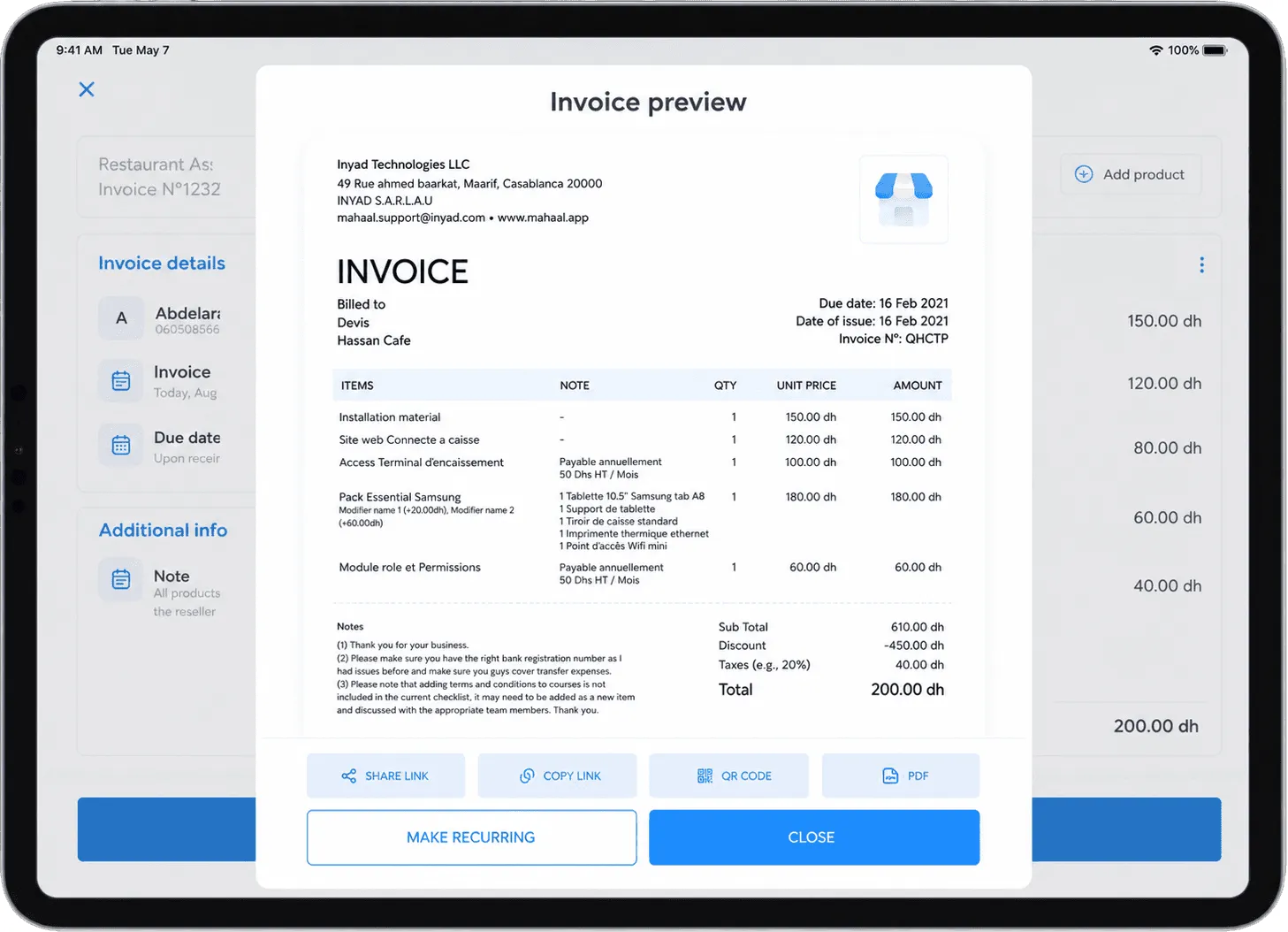
PINT AE: the UAE data format
If Peppol is the network, PINT AE is the shape every invoice must take on it. PINT stands for Peppol International, a common invoice model used across countries. AE is the country code of the UAE. PINT AE is the UAE data dictionary built on that model: it says which fields a UAE e-invoice must carry and how each one is filled in.
Most of those fields will look familiar, because they mirror what a UAE tax invoice already shows: the words "Tax Invoice", the supplier's name, address and Tax Registration Number (TRN), the customer's details where they are registered, a sequential invoice number, dates, line items, and VAT at 5 % as standard (0 % for some supplies such as exports). The difference is that each piece of information goes into a defined field, in a defined form, so a computer can check it.
Why a shared international base? Because it means software built for Peppol elsewhere can be adapted to the UAE rather than rebuilt from zero, and businesses that trade across borders deal with a familiar model. The UAE-specific part sits on top: the fields and rules that reflect UAE tax law.
For you, PINT AE is invisible. You will never open a PINT AE file, any more than you open the code behind a web page. What it changes is tolerance for mistakes: a TRN with a missing digit, a customer name that does not match its registration, or a VAT total that does not add up will be caught when the invoice is checked, not weeks later.
You never need to read PINT AE. You need software that writes it, and customer data good enough to fill it.
Peppol and PINT AE for the business owner versus the software
A lot of worry about UAE e-invoicing comes from not knowing which parts are yours. Here is the split.
What you handle
- Choosing and appointing an ASP, directly or through your invoicing software, by your deadline: 30 October 2026 for businesses with revenue of AED 50 million or more, 31 March 2027 for others, as of October 2026.
- Clean customer data: correct legal names, TRNs and addresses for every business customer.
- Clean product data: the right VAT treatment for each product and service.
- One system for invoices: no more invoices from Word files or spreadsheets on the side.
- Your team: making sure the people who issue invoices know what changes.
What your software and ASP handle
- Producing the invoice in PINT AE from what you enter.
- Checking it against the format before it leaves.
- Addressing and delivering it on the Peppol network.
- Reporting the tax data to the FTA.
- Receiving supplier invoices sent to you through the network.
inyad Invoicing issues and receives e-invoices through an Accredited Service Provider on the UAE's Peppol network. On your side, the work looks like it does today: turn a quote into an invoice in one click, let numbering run on its own, raise a credit note when something needs correcting, and find any past invoice in seconds.
Mistakes to avoid with Peppol in the UAE
None of these are technical. They are the everyday habits that cause rejected invoices and late payments once the network is live.
- Thinking a PDF is still enough: once e-invoicing applies to you, an invoice must go through your ASP in PINT AE to count. A PDF copy can still go along for convenience.
- Editing an invoice after sending it: corrections go through a credit note against the original, so both documents stay on record.
- Keeping customer data in people's heads: if the TRN is only in a salesperson's phone, the invoice will fail.
- Waiting for your go-live date to test: the voluntary pilot, open since 1 July 2026, exists so problems surface early. Voluntary participants are exempt from e-invoicing penalties.
- Ignoring incoming invoices: supplier invoices will arrive through the network too. Decide who checks them.
- Trusting old dates: the first ASP deadline already moved from 31 July to 30 October 2026. Check the Ministry of Finance and FTA websites for the current calendar.
Penalties for e-invoicing non-compliance are set by Cabinet Decision No. 106 of 2025. Amounts quoted online vary between sources, so check the decision or ask your tax adviser rather than relying on a figure from an article.
After the switch: faster invoices, faster payment
Peppol and PINT AE are rules, but they bring a real benefit: invoices that arrive complete, in your customer's system, the same day. Fewer invoices get lost or sent back for a missing detail, so fewer payments are delayed.
With inyad Invoicing, you can add a payment link to each invoice so customers pay online from the document, share it on WhatsApp, SMS or email, and set recurring invoices for retainers to go out on schedule. Reports show what is paid, pending and overdue, so the follow-up is a glance, not an afternoon.
Frequently asked questions
Do I need to learn Peppol or PINT AE to invoice in the UAE?
No. They are rules your software and your Accredited Service Provider follow. Your part is to appoint an ASP, keep customer and product data accurate, and issue every invoice from one system.
Is PINT AE the same as Peppol formats used in other countries?
PINT AE is built on the common Peppol International model, then adapted to the UAE with its own data dictionary. The base is shared; the UAE fields and rules are specific to the UAE.
Can I still send my customer a PDF?
Yes, as a copy for convenience. But once e-invoicing applies to you, the invoice that counts is the one sent in PINT AE through your ASP on the Peppol network.
Who reports my invoices to the FTA?
In the 5-corner model, the tax data is passed to the Federal Tax Authority as part of the exchange, through the providers. You do not upload invoices to a portal yourself.
Was this article helpful? Share on WhatsApp Send by email
Peppol-ready invoicing, kept simple
inyad Invoicing issues and receives e-invoices through an Accredited Service Provider on the UAE's Peppol network, with automatic numbering, credit notes and a payment link on each invoice.
Every UAE business will send e-invoices through an Accredited Service Provider. What it does, how to choose one, and when you must have appointed it.
7 min Simplified tax invoice in the UAE: when you can use itThe AED 10,000 rule, what a simplified invoice must show compared with a full one, why your customer cares, and a checklist with examples in AED.
8 min Tax invoice template for the UAE: free model explainedA complete tax invoice model with optional Arabic labels, each field explained, a filled example in AED at 5 % VAT, and the limits of a template.
8 min