
Simplified tax invoice in the UAE: when you can use it
The AED 10,000 rule, what a simplified invoice must show compared with a full one, why your customer cares, and a checklist with examples in AED.
In the UAE, you may issue a simplified tax invoice when your customer is not VAT registered, or is registered and the supply does not exceed AED 10,000. Above that, a registered customer needs a full tax invoice with their name, address and TRN.
Key takeaways
- As of October 2026, a simplified tax invoice in the UAE is allowed in two cases: the recipient is not VAT registered, or the recipient is registered and the supply does not exceed AED 10,000.
- Above AED 10,000 to a registered business, the Federal Tax Authority (FTA) expects a full tax invoice with the recipient's name, address and TRN.
- Both documents show the words "Tax Invoice", your name, address and TRN, a sequential number, the date and the VAT at 5 %. The full version adds the recipient's details.
- Your registered customer relies on your invoice to support the VAT they recover. When in doubt, send the full tax invoice: it costs you nothing and removes the question.
- E-invoicing through an Accredited Service Provider (ASP) starts on 1 July 2027 for businesses below AED 50 million, so build clean customer records now.
What a simplified tax invoice in the UAE is
A simplified tax invoice is a lighter version of the UAE tax invoice. It exists so that a shop, a café or a service business can issue a VAT document quickly for small or consumer sales, without collecting the full details of every buyer.
It is still a tax invoice. It still shows that the sale happened and that you charged VAT. What changes is how much information it carries about the person you sold to. A consumer buying a coffee does not have a TRN, and asking for an address at the till would make no sense.
If your business is VAT registered with the FTA, you issue one of the two documents for every taxable supply. The question is which one, and the answer depends on two things only: whether your customer is registered, and how much the supply is worth.
The AED 10,000 rule for a simplified tax invoice in the UAE
As of October 2026, the rule is short. You may issue a simplified tax invoice when:
- The recipient is not registered for VAT: a consumer, a tourist, or a business that is below the registration threshold or simply not registered. The amount does not matter in this case.
- The recipient is registered and the supply does not exceed AED 10,000: a small sale to another VAT-registered business.
In every other case, which means a supply above AED 10,000 to a registered recipient, you issue a full tax invoice.
Two practical points help here. First, the rule looks at the recipient, so you need to know whether your customer is registered. Ask for their TRN when you open the account, not when you issue the invoice. Second, when an amount sits close to AED 10,000, do not try to work out which side of the line it falls on. Issue a full tax invoice. It is always acceptable where a simplified one would be, while the reverse is not true.
Also check the registration status of your own business. As of October 2026, VAT registration is mandatory once taxable supplies and imports pass AED 375,000 over 12 months, and voluntary from AED 187,500. If you are not registered, you have no TRN and you issue neither kind of tax invoice.
A full tax invoice is always acceptable where a simplified one would be. The reverse is not true.
Simplified tax invoice vs full tax invoice: what each one contains
The two documents share a common core. As of October 2026, both carry:
- The words "Tax Invoice": clearly shown, so the document cannot be confused with a quote or a delivery note.
- Your name, address and TRN: the supplier's identity and Tax Registration Number.
- A sequential number: one continuous sequence, without gaps or duplicates.
- The date: the date of issue, and the date of supply where it differs.
- The VAT: the amount of VAT charged, or a total that clearly includes VAT at 5 %.
The full tax invoice adds:
- The recipient's details: the registered customer's name, address and TRN.
- A detailed breakdown: in practice, each line with its description, quantity, unit price, VAT rate and VAT amount, then the totals before VAT, the VAT and the total payable in AED.
The simplified version can be as short as a till receipt, provided the core fields are there. The FTA's guidance lists the exact particulars for each type, and they can change, so check it when you design your templates.
Input tax: why your customer cares which one you send
For a consumer, the type of invoice does not matter much. For a VAT-registered business, it matters a lot. A registered business recovers the VAT it pays on its purchases, the input tax, and it needs proper invoices to support that recovery.
A full tax invoice in the buyer's name, with their TRN, is the clearest support they can have. A simplified invoice that does not name the buyer is weaker evidence that the purchase belonged to their business. Whether a simplified invoice is enough to support recovery in a given case is a question for the FTA's guidance or your tax adviser, so confirm it before you rely on it.
The practical answer for a small business is simple. When a registered customer asks for a tax invoice, give them the full version, whatever the amount. Most disputes about invoices are not about money. They are about a document the customer's accountant cannot use, and an invoice that has to be reissued weeks later.
Examples in AED at 5 % VAT
Four everyday cases show how the rule works. VAT is 5 %, calculated on the amount before VAT.
- A salon client paying for a treatment: AED 400 before VAT, VAT AED 20, total AED 420. The client is a consumer, not registered. A simplified tax invoice is enough.
- A furniture shop selling a sofa to a family: AED 12,000 before VAT, VAT AED 600, total AED 12,600. The buyer is not registered, so a simplified tax invoice is allowed even above AED 10,000.
- A stationery supplier delivering to a registered office: AED 4,000 before VAT, VAT AED 200, total AED 4,200. The buyer is registered and the supply is below AED 10,000. A simplified tax invoice is allowed, but the customer will probably ask for the full version to support their recovery.
- An IT company installing a network for a registered client: AED 15,000 before VAT, VAT AED 750, total AED 15,750. The buyer is registered and the supply exceeds AED 10,000. A full tax invoice is required.
Remember the calculation in both directions. From before VAT to total, multiply by 1.05: AED 4,000 × 1.05 = AED 4,200. From a VAT-inclusive total back to the amount before VAT, divide by 1.05: AED 4,200 ÷ 1.05 = AED 4,000. Subtracting 5 % from AED 4,200 gives AED 3,990, which is wrong.
Every inyad Invoicing invoice can carry a payment link, so your customer pays by card from WhatsApp, SMS or email.
Discover inyad Invoicing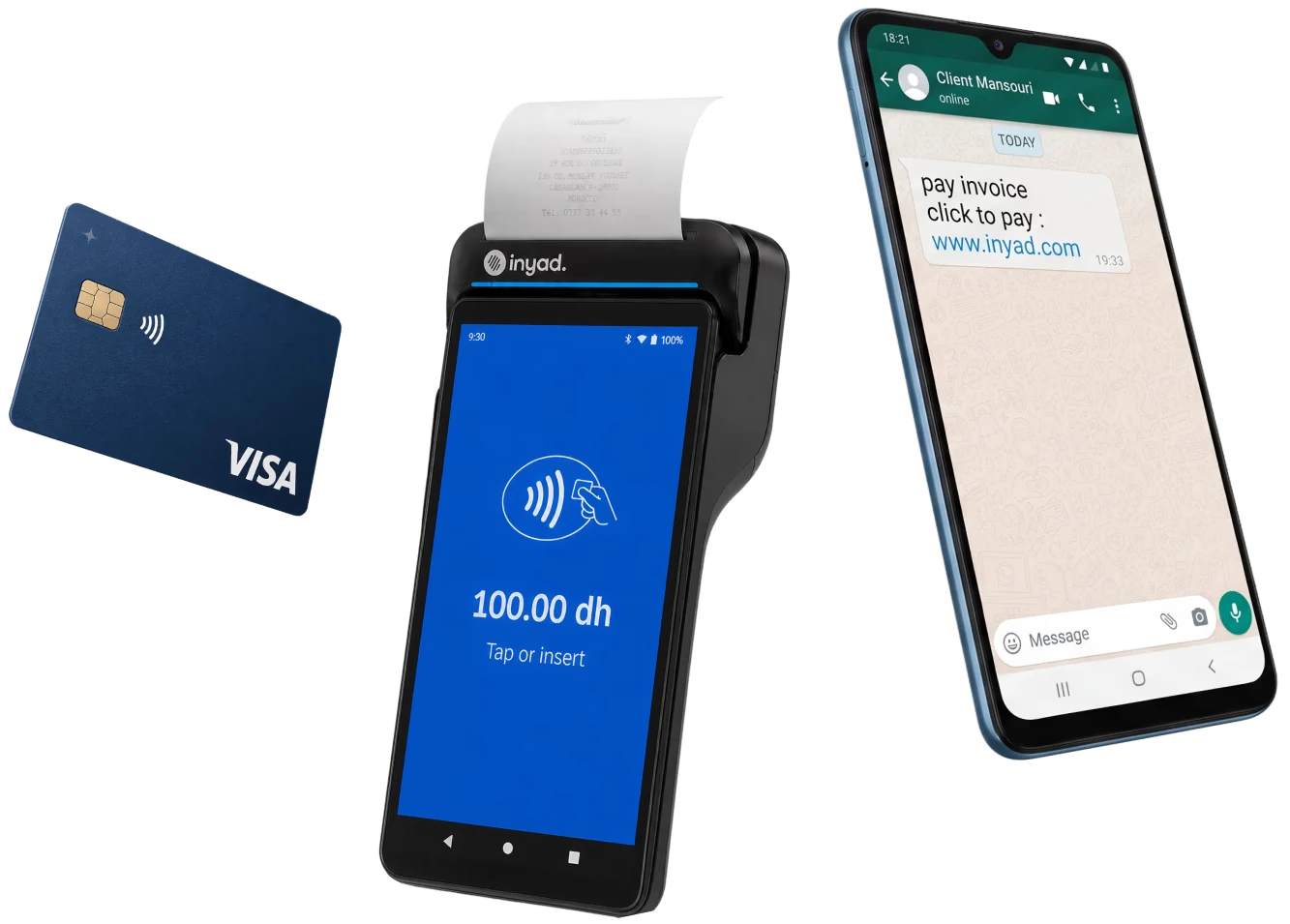
A decision checklist before you issue the invoice
Run through these questions in order. The first "no" or "yes" that settles it gives you the answer.
- Is my business VAT registered? If not, issue a normal invoice without VAT. Neither tax invoice applies.
- Is the customer VAT registered? If not, a simplified tax invoice is allowed. You may still issue a full one if they ask.
- Does the supply exceed AED 10,000? If the customer is registered and the answer is yes, issue a full tax invoice.
- Does the customer want to recover the VAT? If they are registered and ask for a tax invoice, issue the full version, whatever the amount.
- Is the amount close to AED 10,000? Issue a full tax invoice and move on.
- Is the sale part of an e-invoicing flow? From your start date, check which of your invoices must travel as PINT AE e-invoices through your ASP.
The checklist is easier to follow when the software already knows your customers. In inyad Invoicing, each customer record keeps their TRN and address, so a full tax invoice fills itself in, numbers itself in sequence and goes out on WhatsApp, SMS or email with a payment link.
What e-invoicing changes for simplified and full tax invoices in the UAE
The UAE is introducing e-invoicing on a Peppol-based model. As of October 2026, businesses do not connect to a government portal: they send and receive e-invoices through an Accredited Service Provider, in the PINT AE format, the UAE data dictionary on the Peppol PINT specification.
The timeline depends on size. A voluntary pilot has been open since 1 July 2026. Businesses with revenue of AED 50 million or more must appoint an ASP by 30 October 2026 and issue e-invoices from 1 January 2027. Businesses below AED 50 million must appoint an ASP by 31 March 2027, with e-invoicing mandatory from 1 July 2027. These dates have already moved once, so confirm them on the Ministry of Finance and FTA websites.
Which of your sales fall in scope, and how simplified invoices for consumers are treated, should be checked against the official rules for your business. What is certain is that the full tax invoice data you collect today, starting with your customers' TRNs, is exactly what an e-invoice will need. inyad Invoicing issues and receives e-invoices through an Accredited Service Provider on the UAE's Peppol network, so the step to e-invoicing does not mean changing tools.
Frequently asked questions
Can I issue a simplified tax invoice for any sale to a consumer?
Yes, as of October 2026, a simplified tax invoice is allowed whenever the recipient is not VAT registered, whatever the amount. It must still show the words "Tax Invoice", your name, address and TRN, a sequential number, the date and the VAT. If the consumer asks for a full tax invoice, you can issue one.
Is the AED 10,000 limit counted before or after VAT?
The FTA's rule refers to the value of the supply. To avoid any doubt, do not rely on a calculation close to the limit: when a sale to a registered customer is anywhere near AED 10,000, issue a full tax invoice. It is always acceptable, and it saves a discussion later. Check the FTA's guidance if you need the exact basis.
Do simplified and full tax invoices share the same number sequence?
Each invoice needs a unique number in a continuous sequence. Many businesses use one sequence for all their tax invoices, which is the simplest way to avoid gaps and duplicates. If you use separate sequences, for example one per point of sale, make sure each stays continuous and that no number is ever used twice.
What if I sent a simplified tax invoice and the customer needs a full one?
Do not edit the invoice already issued. The cleanest route is to cancel it with a credit note that refers to it, then issue a full tax invoice with the customer's name, address and TRN. Your number sequence stays intact and both sides keep a clear record.
Was this article helpful? Share on WhatsApp Send by email
The right tax invoice, filled in for you
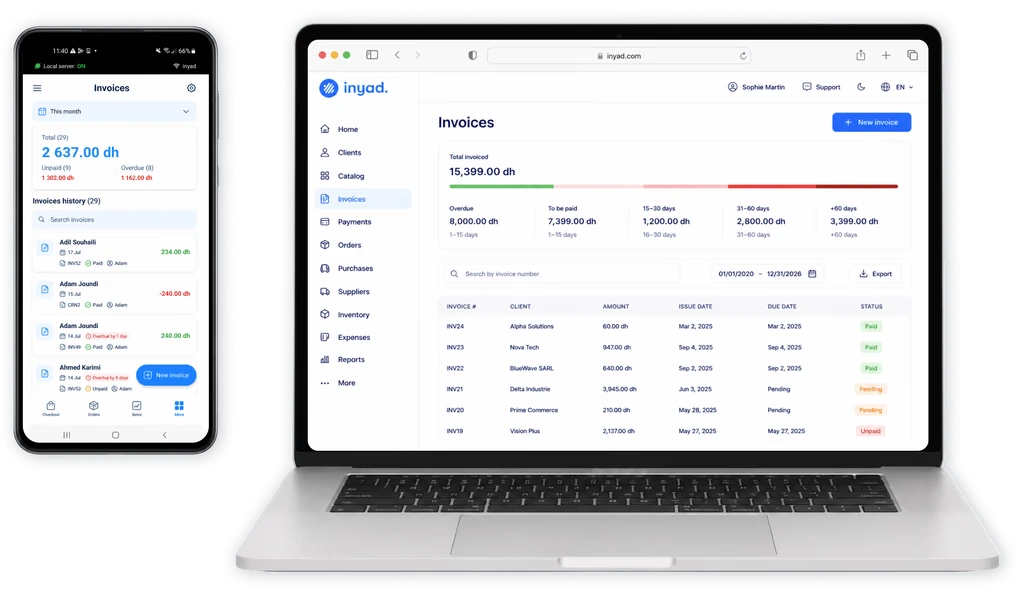
inyad Invoicing keeps each customer's TRN and address, numbers every invoice in sequence, applies 5 % VAT per line and sends the invoice on WhatsApp, SMS or email, and it issues and receives e-invoices through an Accredited Service Provider on the UAE's Peppol network.
Every UAE business will send e-invoices through an Accredited Service Provider. What it does, how to choose one, and when you must have appointed it.
7 min Peppol and PINT AE: UAE e-invoicing explained simplyPeppol is the network, PINT AE is the UAE invoice format. What each means, how an invoice travels in five steps, and what is your job or your software's.
7 min Tax invoice template for the UAE: free model explainedA complete tax invoice model with optional Arabic labels, each field explained, a filled example in AED at 5 % VAT, and the limits of a template.
8 min