
E-invoicing in the UAE: the complete guide for 2026–2027
How the UAE e-invoicing model works, who must join and when, what changes on your invoices, and a plain plan to get ready before your date.
UAE e-invoicing runs on a Peppol-based network: you send and receive invoices through an Accredited Service Provider, in the PINT AE format. As of October 2026, large businesses go live on 1 January 2027 and the rest on 1 July 2027.
Key takeaways
UAE e-invoicing is coming in stages over 2027, and the first deadlines are already close. Here is what matters most, as of October 2026.
- The model: invoices travel between businesses on a Peppol-based network, through Accredited Service Providers (ASPs), in a UAE format called PINT AE.
- Large businesses (revenue of AED 50 million or more): appoint an ASP by 30 October 2026, e-invoicing mandatory from 1 January 2027.
- All other businesses: appoint an ASP by 31 March 2027, mandatory from 1 July 2027. Government entities follow on 1 October 2027.
- Penalties exist for non-compliance under Cabinet Decision No. 106 of 2025. Voluntary participants are exempt.
- Dates have already moved once, so confirm yours on the Ministry of Finance and Federal Tax Authority (FTA) websites before you plan.
What UAE e-invoicing is, in plain words
Today, many UAE businesses still send invoices as PDF files by email, or print them. A PDF looks like an invoice to a person, but a computer cannot read it reliably. UAE e-invoicing replaces that with a structured invoice: a data file where every field (seller, buyer, TRN, amounts, VAT) sits in a fixed place, so the buyer's system and the tax authority can read it without anyone retyping it.
The point is not the look of the invoice. It is the data inside it, and the route it takes. Under the new rules, an invoice is only an e-invoice if it is issued in the agreed format and sent through the agreed network. A PDF attached to an email will not count, even if it shows every required detail.
For you as a business owner, the day-to-day change is smaller than it sounds. You keep creating invoices in your invoicing software. What changes is what happens when you press send: the software hands the invoice to your provider, and the provider delivers it to your customer and reports the data to the tax authority.
You do not connect to a government portal. You connect to an Accredited Service Provider, and it carries your invoices.
How the UAE e-invoicing model works: Peppol, ASP and PINT AE
The UAE chose a model often called "5-corner", or DCTCE (decentralised continuous transaction control and exchange). Three words explain it.
Peppol, the network
Peppol is an international network and set of rules for exchanging business documents. It is already used in many countries. Think of it as a postal system for invoices: everyone connected follows the same addressing and delivery rules, so an invoice sent by one provider arrives at any other.
The Accredited Service Provider, your access point
You do not plug into Peppol yourself, and you do not upload invoices to a government portal. You appoint an Accredited Service Provider (ASP), a company accredited in the UAE to connect businesses to the network. Your ASP checks your invoice, sends it to your customer's ASP, and passes the tax data on to the FTA.
PINT AE, the format
PINT AE is the UAE version of the Peppol invoice format. It is a data dictionary: the list of fields a UAE invoice must contain, and how each must be filled in. Your software produces it; you never need to read it.
Put together, the five corners are: you (the supplier), your ASP, your customer's ASP, your customer, and the FTA, which receives the tax data. Our guide to Peppol and PINT AE walks through this flow step by step.
Who UAE e-invoicing concerns, and the timeline
As of October 2026, the Ministry of Finance has set the schedule below. It applies to businesses in the UAE, in waves by size. The model is built around invoices exchanged between businesses and with government entities; check the current scope on the Ministry of Finance site for other kinds of sales.
- Voluntary pilot: open since 1 July 2026 for businesses that want to start early.
- Businesses with revenue of AED 50 million or more: appoint an ASP by 30 October 2026 (this was extended from 31 July 2026). E-invoicing mandatory from 1 January 2027.
- Businesses with revenue below AED 50 million: appoint an ASP by 31 March 2027. E-invoicing mandatory from 1 July 2027.
- Government entities: appoint an ASP by 31 March 2027. E-invoicing mandatory from 1 October 2027.
If you are a large business and have not appointed an ASP yet, your deadline is 30 October 2026. If you are a smaller business, July 2027 sounds far, but you still need to choose a provider, update your software and clean your customer data before 31 March 2027.
The dates have already moved once. Treat this list as a planning base, and confirm your own dates on the Ministry of Finance and FTA websites. How revenue is measured for your business is also worth checking with your tax adviser if you sit close to the AED 50 million line.
What changes on your invoices
The rules for what a valid invoice shows do not disappear. As of October 2026, a UAE tax invoice still shows the words "Tax Invoice", the supplier's name, address and Tax Registration Number (TRN), the recipient's details where they are registered, a sequential invoice number, the dates, and the VAT. A simplified tax invoice is still allowed when the recipient is not VAT registered, or is registered and the supply does not exceed AED 10,000.
What changes is how strictly those details are checked. Under e-invoicing:
- Every field is structured: a missing TRN or a wrong VAT figure is caught by the system, not discovered at an audit.
- Your customer data must be clean: correct legal names, TRNs and addresses for every business customer, so invoices can be addressed on the network.
- Corrections go through credit notes: you do not edit an invoice already sent; you issue a credit note against it.
- VAT stays the same: the standard rate is 5 %, with 0 % for some supplies such as exports. E-invoicing changes the channel, not the rate.
As a reminder, VAT registration is mandatory above AED 375,000 of taxable supplies and imports over 12 months, and voluntary from AED 187,500. These thresholds are separate from the e-invoicing waves.
In inyad Invoicing, every invoice and credit note is numbered and stored, with paid, pending and overdue amounts at a glance.
Discover inyad Invoicing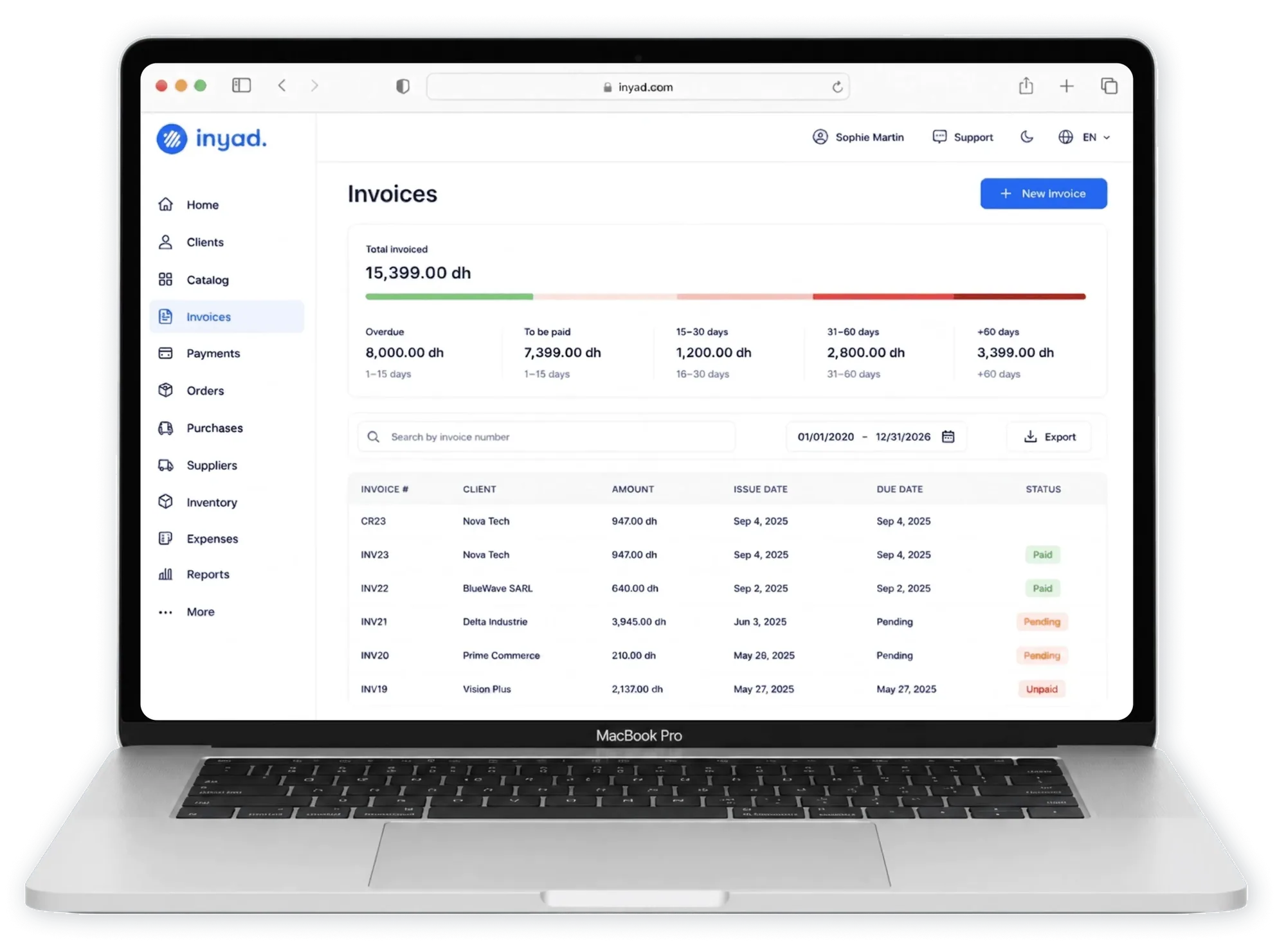
Penalties for UAE e-invoicing non-compliance
Cabinet Decision No. 106 of 2025 sets administrative penalties for businesses that do not follow the e-invoicing rules once they apply to them. Participants in the voluntary pilot are exempt.
You will see different penalty amounts quoted in different articles. We do not repeat them here, because the figures vary between sources and can change. If you want the exact amounts, read the decision itself or ask your tax adviser. The useful point is simpler: from your go-live date, an invoice that does not go through an ASP in the right format is a compliance problem, not just an admin detail.
How to prepare for UAE e-invoicing, step by step
Start from your go-live date and work backwards. Most businesses can get ready in a few months if they start in the right order.
- Confirm your wave. Check your revenue against the AED 50 million line and note your ASP deadline and go-live date.
- List every place an invoice is born. Your invoicing tool, your accounting system, a spreadsheet the sales team uses, a branch that still writes invoices by hand. Each one must end up producing e-invoices.
- Choose and appoint an ASP. Ask your current software provider how it connects to the network first: it may already work through an ASP, which saves you a separate project.
- Clean your customer and product data. Legal names, TRNs, addresses, and VAT treatment for each product or service.
- Test before the deadline. Send real invoices to a few friendly customers. The voluntary pilot exists for this.
- Brief your team and your customers. Tell the people who issue invoices what changes, and tell your customers they will receive invoices through the network.
inyad Invoicing issues and receives e-invoices through an Accredited Service Provider on the UAE's Peppol network. You keep working the way you do now: turn a quote into an invoice in one click, let numbering run automatically, raise credit notes for corrections, and keep every document stored and searchable.
Getting paid faster once you switch
E-invoicing is a legal obligation, but it is also a chance to fix slow payments. When invoices are structured and delivered straight into your customer's system, fewer of them get lost in an inbox or rejected for a missing detail.
With inyad Invoicing, each invoice can carry a payment link so customers can pay online from the document itself, and you can share it on WhatsApp, SMS or email. Recurring invoices for retainers and subscriptions go out on schedule, and reports show at a glance what is paid, outstanding or overdue.
Frequently asked questions
Is a PDF invoice sent by email still valid after my go-live date?
Once e-invoicing applies to your business, an invoice must be issued in the PINT AE format and sent through an Accredited Service Provider to count as an e-invoice. You can still send your customer a PDF copy for their convenience, but the PDF alone will not meet the rule.
Do I need to connect to an FTA portal?
No. The UAE model does not use a central portal where you upload invoices. Your ASP exchanges invoices with your customer's ASP on the Peppol network and passes the tax data to the FTA for you.
What if my revenue is below AED 50 million?
As of October 2026, you must appoint an ASP by 31 March 2027, and e-invoicing becomes mandatory for you on 1 July 2027. You can join the voluntary pilot earlier if you want time to test.
Can the deadlines change again?
Yes. The deadline for large businesses to appoint an ASP was already extended once, from 31 July to 30 October 2026. Check the Ministry of Finance and FTA websites regularly, and plan to be ready early rather than counting on another extension.
Was this article helpful? Share on WhatsApp Send by email
Invoice now, ready for the network
inyad Invoicing turns quotes into numbered invoices, credit notes and recurring bills with a payment link, and issues and receives e-invoices through an Accredited Service Provider on the UAE's Peppol network.
Every UAE business will send e-invoices through an Accredited Service Provider. What it does, how to choose one, and when you must have appointed it.
7 min Peppol and PINT AE: UAE e-invoicing explained simplyPeppol is the network, PINT AE is the UAE invoice format. What each means, how an invoice travels in five steps, and what is your job or your software's.
7 min Simplified tax invoice in the UAE: when you can use itThe AED 10,000 rule, what a simplified invoice must show compared with a full one, why your customer cares, and a checklist with examples in AED.
8 min