
UAE e-invoicing for small businesses: the July 2027 deadline
Below AED 50 million in revenue, you appoint an ASP by 31 March 2027 and e-invoice from 1 July 2027. Here is how the model works and a plan to get ready.
As of October 2026, UAE businesses with revenue below AED 50 million must appoint an Accredited Service Provider by 31 March 2027 and issue e-invoices from 1 July 2027. Start now with clean customer TRNs, one invoice sequence and the right software.
Key takeaways
- As of October 2026, UAE e-invoicing for small businesses, meaning those with revenue below AED 50 million, has two dates: appoint an Accredited Service Provider (ASP) by 31 March 2027, and issue e-invoices from 1 July 2027.
- There is no government portal to log into. You send and receive e-invoices through your ASP on the Peppol network, in the PINT AE format.
- The dates have already moved once. Confirm them on the Ministry of Finance and Federal Tax Authority (FTA) websites before you plan.
- Cabinet Decision No. 106 of 2025 sets administrative penalties for non-compliance. Voluntary participants are exempt, so testing early costs nothing in penalties.
- The real work is your data: customer TRNs, addresses, item descriptions and one clean invoice sequence. Start there this quarter.
UAE e-invoicing for small businesses: the dates that apply to you
The UAE is replacing PDF and paper invoices with structured e-invoices exchanged between businesses' systems. The rollout is staged by size, and most small and medium businesses fall in the second group.
As of October 2026, the timeline is:
- Voluntary pilot: open since 1 July 2026, for businesses that want to start early.
- Revenue of AED 50 million or more: appoint an ASP by 30 October 2026 (extended from 31 July 2026), mandatory from 1 January 2027.
- Revenue below AED 50 million: appoint an ASP by 31 March 2027, mandatory from 1 July 2027.
- Government entities: appoint an ASP by 31 March 2027, mandatory from 1 October 2027.
If your revenue is below AED 50 million, your two dates are 31 March 2027 and 1 July 2027. That leaves roughly five months to choose a provider and about nine months before your first mandatory e-invoice. It sounds like a lot. It is not, once you count the time to clean your customer records, test, and train the people who issue invoices.
The large-business deadline was extended once already. Dates can move again, in either direction, so check the Ministry of Finance and FTA websites when you plan, and again before each milestone. Whether a business that is not VAT registered falls in scope is also a point to confirm with the official guidance for your situation.
How the UAE model works: ASP, Peppol and PINT AE
The UAE chose a model that is different from a central portal. As of October 2026, it works like this:
- You appoint an Accredited Service Provider: a provider accredited to connect businesses to the network. You do not connect to a government system yourself.
- Your invoices travel on Peppol: an international network for exchanging e-invoices. Your ASP sends to your customer's ASP, which delivers to your customer.
- The format is PINT AE: the UAE data dictionary built on the Peppol PINT specification. Every field, from your TRN to each VAT line, has a fixed place.
- The model is often called 5-corner: you, your customer and the two providers make four corners. The tax authority receiving the invoice data is the fifth.
For a small business, the consequence is practical. You will not type invoices into a website. Your invoicing software produces the e-invoice, and your ASP carries it. So the choice of software and the choice of ASP are linked: either the software works with an ASP, or you will be copying data between two systems.
A business that starts now meets 1 July 2027 as a routine day. A business that starts in May meets it as a project.
VAT basics to settle before e-invoicing
E-invoicing does not change VAT. It carries it. If your VAT treatment is unclear today, an e-invoice will only make the error faster and more visible. Check these points first, as of October 2026:
- Rates: VAT is 5 % on most supplies, with 0 % on some supplies such as exports. Each item in your catalogue should carry the right rate.
- Registration: mandatory once taxable supplies and imports pass AED 375,000 over 12 months, voluntary from AED 187,500. Your TRN goes on every tax invoice.
- Tax invoice content: the words "Tax Invoice", your name, address and TRN, the recipient's details where registered, a sequential number, the dates and the VAT.
- Simplified tax invoices: allowed when the recipient is not registered, or is registered and the supply does not exceed AED 10,000.
A quick test: take an invoice of AED 2,000 before VAT. The VAT is AED 100 and the total AED 2,100. Going back from AED 2,100, divide by 1.05 to get AED 2,000. If your current tool or spreadsheet ever gives you AED 1,995, fix that before anything else.
A practical plan for a small business, quarter by quarter
Work backwards from 1 July 2027. Here is a plan that fits a business with one person handling invoices, and scales to a small finance team.
- Now to December 2026: map your invoicing. List every kind of invoice you issue (to businesses, to government, to consumers), every credit note, and every invoice you receive from suppliers. Note who issues them and with which tool.
- Now to December 2026: clean your customer data. Collect the TRN and legal address of every registered customer. Fix duplicates. An e-invoice with a wrong TRN is an e-invoice that fails.
- By January 2027: clean your catalogue. Give every product and service a clear description, a unit and the right VAT rate. Vague lines are harder to map into a structured format.
- By February 2027: choose your software and your ASP. Ask whether the software issues and receives e-invoices through an ASP, how credit notes are handled, and what support you get in your language.
- By 31 March 2027: appoint your ASP. This is the formal deadline for businesses below AED 50 million, as of October 2026.
- April to June 2027: test and train. Send real invoices to a few friendly customers, receive a few from suppliers, and check that numbers, VAT and credit notes come out right. Train everyone who issues invoices.
- From 1 July 2027: run and review. Check rejected or failed invoices every day for the first weeks, then weekly.
If you can, join the voluntary pilot. As of October 2026, it has been open since 1 July 2026, and voluntary participants are exempt from the penalties under Cabinet Decision No. 106 of 2025. That makes it the cheapest place to learn.
In inyad Invoicing, every document comes from the same catalogue and client records, so the data your e-invoices need is already clean.
Discover inyad Invoicing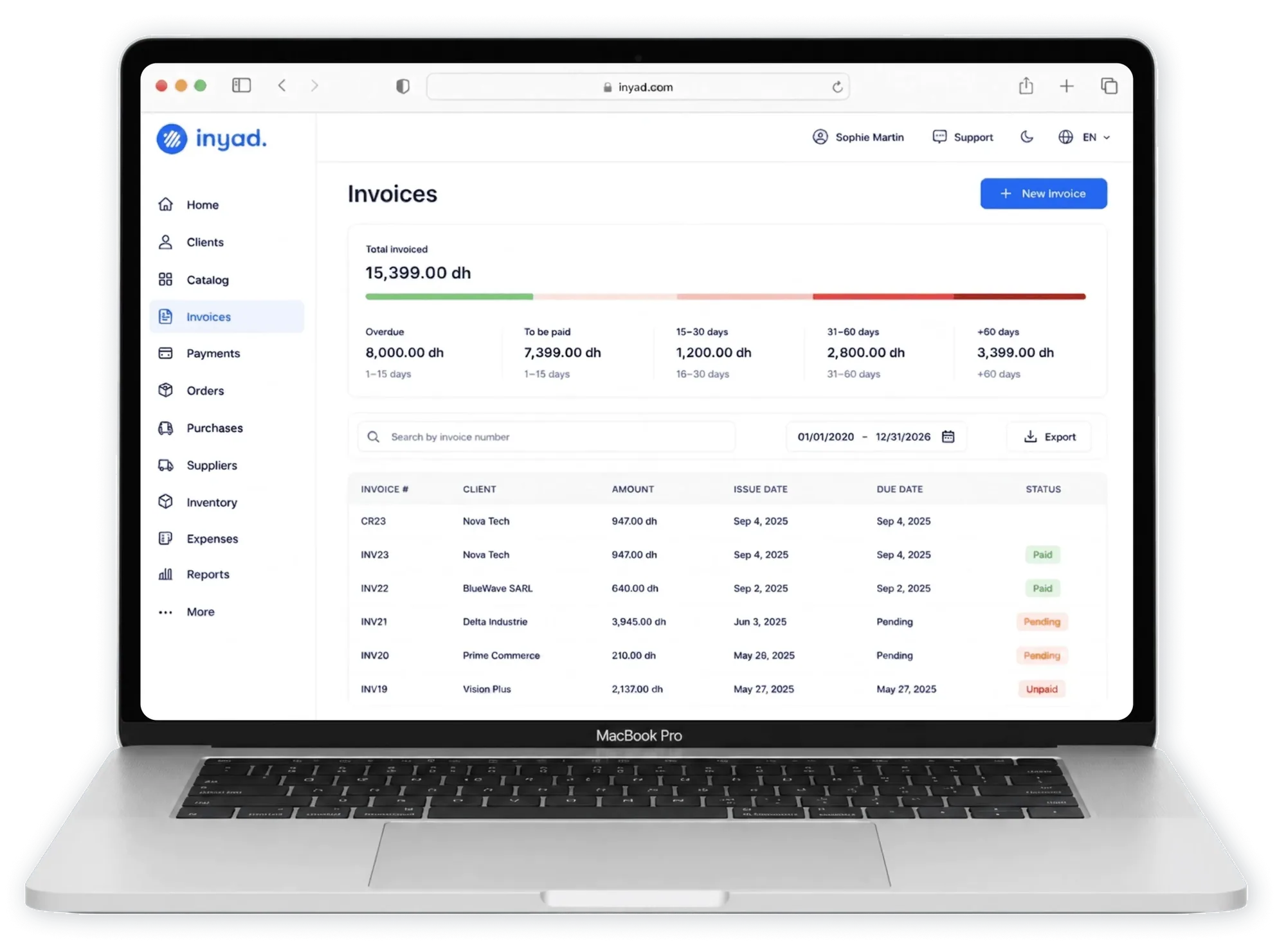
The cost of waiting until spring 2027
The penalty amounts are set by Cabinet Decision No. 106 of 2025, and published figures vary between sources, so check the official text rather than a summary. But penalties are not the main cost of waiting. The everyday costs come first:
- Rushed choices: when every business below AED 50 million looks for a provider in the same few weeks, you choose under pressure and get less attention.
- Data clean-up at the worst time: chasing customer TRNs in June means chasing them while you also need to invoice.
- Blocked invoices: if a customer's system cannot read your invoice, or your invoice is not sent in the required format, payment can wait while you fix it.
- Two systems for a while: a late switch often means running old spreadsheets and new software side by side, with double entry and gaps in numbering.
- Untrained staff: the first month of a new process is slow. Better that month falls during a pilot than during your busiest quarter.
A business that starts now meets 1 July 2027 as a routine day. A business that starts in May meets it as a project.
What to look for in e-invoicing software as a small UAE business
You do not need an ERP to issue e-invoices. You need a tool that does the everyday invoicing well and connects to the network. Check for:
- ASP connection: issuing and receiving e-invoices through an Accredited Service Provider, without exporting files by hand.
- Clean records by design: customer TRNs stored once, sequential numbering generated automatically, VAT per line.
- Corrections done properly: credit notes raised against the original invoice, never edits to a sent one.
- The rest of the cycle: quotes that turn into invoices, recurring invoices for retainers, and a payment link so customers pay from the invoice.
- Sending where your customers are: on WhatsApp, SMS or email, alongside the e-invoice itself.
inyad Invoicing was built for this kind of business. It handles quotes, invoices, credit notes, recurring invoices and payment links in one place, and inyad Invoicing issues and receives e-invoices through an Accredited Service Provider on the UAE's Peppol network.
Frequently asked questions
My revenue is below AED 50 million. When must I start e-invoicing?
As of October 2026, businesses below AED 50 million must appoint an Accredited Service Provider by 31 March 2027, and e-invoicing becomes mandatory for them from 1 July 2027. The dates for larger businesses have already been extended once, so confirm yours on the Ministry of Finance and FTA websites before you plan.
Do I need to register on a government e-invoicing portal?
No. The UAE model does not use a government portal for sending invoices. You appoint an ASP, and your e-invoices travel through it on the Peppol network in the PINT AE format. Your software and your ASP handle the exchange with your customers and suppliers.
Can I join before my mandatory date?
Yes. As of October 2026, a voluntary pilot has been open since 1 July 2026. Voluntary participants are exempt from the administrative penalties set by Cabinet Decision No. 106 of 2025, which makes the pilot a low-risk way to test your setup before 1 July 2027.
Will I still be able to send invoices on WhatsApp?
For invoices in scope, the e-invoice itself must go through your ASP. You can still send your customer a readable copy and a payment link on WhatsApp, SMS or email, which is often what gets you paid faster. Check which of your transactions are in scope with the official guidance.
Was this article helpful? Share on WhatsApp Send by email
Ready for e-invoicing before July 2027
inyad Invoicing handles quotes, e-invoices, credit notes, recurring invoices and payment links in one place, and it issues and receives e-invoices through an Accredited Service Provider on the UAE's Peppol network.
Every UAE business will send e-invoices through an Accredited Service Provider. What it does, how to choose one, and when you must have appointed it.
7 min Peppol and PINT AE: UAE e-invoicing explained simplyPeppol is the network, PINT AE is the UAE invoice format. What each means, how an invoice travels in five steps, and what is your job or your software's.
7 min Simplified tax invoice in the UAE: when you can use itThe AED 10,000 rule, what a simplified invoice must show compared with a full one, why your customer cares, and a checklist with examples in AED.
8 min