
ZATCA e-invoicing in Saudi Arabia: the complete guide
Phase 1 and Phase 2, the latest waves and deadlines, tax and simplified invoices, credit notes, retention and a step plan to get ready.
ZATCA e-invoicing has two phases: electronic generation since December 2021, and integration with FATOORA, rolled out in waves by revenue. As of October 2026, Wave 25 covers businesses above SAR 187,500 and must integrate by 1 February 2027.
Key takeaways
- ZATCA e-invoicing in Saudi Arabia has two phases: Phase 1 (generation), in force since 4 December 2021, and Phase 2 (integration with the FATOORA platform), rolled out in waves.
- As of October 2026, Wave 23 (deadline 31 March 2026) and Wave 24 (deadline 30 June 2026) have passed. Wave 25 covers businesses above SAR 187,500 of VAT-taxable revenue in any one year from 2022 to 2025, with a deadline of 1 February 2027.
- There are two invoice types: the tax invoice for business and government buyers, cleared by FATOORA before the buyer receives it, and the simplified tax invoice for consumers, reported within 24 hours.
- An issued invoice is never edited. Returns and corrections go through electronic credit or debit notes that reference the original invoice.
- E-invoices and notes must be kept for at least 6 years, inside the Kingdom.
ZATCA e-invoicing is no longer a project for later. If you sell in Saudi Arabia and you are registered for VAT, every invoice you issue already has to come from an electronic solution, and a growing number of businesses must also connect that solution to ZATCA’s FATOORA platform. This guide explains what each phase asks of you, which wave you may be in, how the two invoice types differ, and what to do this month to get ready.
Everything below reflects the rules as of October 2026. ZATCA updates its guidance and announces new waves regularly, so treat this as a map and confirm the details for your own business on ZATCA’s official channels.
What ZATCA e-invoicing means for a Saudi business
The Zakat, Tax and Customs Authority (ZATCA) runs e-invoicing in the Kingdom. The idea is simple: invoices are created as structured electronic records by a compliant system, not typed in a word processor or written by hand. The record carries the same commercial information as a paper invoice, but in a format ZATCA can read and check.
For the business, this changes three things. First, the tool you use to invoice matters: a spreadsheet template or a scanned PDF is not an e-invoice. Second, invoices become hard to alter after the fact, which protects you as much as it protects the tax authority. Third, once you are in Phase 2, ZATCA sees your invoices as you issue them, so your VAT return and your invoicing must agree.
The rules apply to VAT-registered businesses and to anyone who issues invoices on their behalf. The standard VAT rate is 15 %, and every tax invoice shows the seller’s 15-digit VAT registration number.
A spreadsheet invoice is not an e-invoice, even saved as a PDF.
Phase 1 and Phase 2 of ZATCA e-invoicing
Phase 1: generation
Since 4 December 2021, invoices must be generated electronically from a compliant solution. In practice, that means your invoicing tool must produce numbered invoices that cannot be quietly deleted or changed, keep a record of every document, and print a QR code on simplified tax invoices so anyone can scan the key details.
Phase 1 does not require you to send invoices to ZATCA in real time. It is about how invoices are created and stored. If you are below every Phase 2 threshold, Phase 1 is still your obligation today.
Phase 2: integration with FATOORA
Phase 2 connects your invoicing solution to ZATCA’s FATOORA platform. Your system exchanges each invoice with the platform in a defined electronic format. Tax invoices are cleared by FATOORA before you share them with the buyer, and simplified tax invoices are reported to FATOORA within 24 hours of being issued.
Phase 2 is not switched on for everyone at once. ZATCA applies it in waves, each defined by a VAT-taxable revenue threshold, and it notifies the businesses in each wave in advance. The first waves covered the largest taxpayers; recent waves have reached much smaller businesses.
ZATCA Phase 2 waves: who is in scope
Here are the most recent waves as of October 2026. The revenue figures are VAT-taxable revenue, not total turnover.
- Wave 23: businesses with VAT-taxable revenue above SAR 750,000 in 2022, 2023 or 2024. Integration deadline: 31 March 2026.
- Wave 24: businesses above SAR 375,000 over the same period. Integration deadline: 30 June 2026.
- Wave 25: businesses above SAR 187,500 in any one year from 2022 to 2025. Announced in July 2026, integration deadline 1 February 2027.
If you crossed SAR 187,500 of VAT-taxable revenue in even one of those years, plan as though you are in Wave 25 and watch for ZATCA’s notification. If you are below every threshold so far, you remain under Phase 1, but a future wave may lower the bar again. Your ZATCA account and your tax adviser are the reliable places to confirm your status.
Missing your deadline is not a paperwork detail. ZATCA publishes a list of e-invoicing violations and the penalties attached to them. We do not quote amounts here because published figures vary between sources; check the current violations guidance directly with ZATCA.
Invoice types under ZATCA e-invoicing
The tax invoice
The tax invoice is for sales to other businesses and to government entities. It carries the full buyer details, including the buyer’s VAT number when they are registered. In Phase 2, it is cleared by FATOORA before it reaches the buyer, which is why the buyer can rely on it to deduct the input VAT they paid.
The simplified tax invoice
The simplified tax invoice is for sales to consumers. It needs fewer buyer details, carries a QR code, and in Phase 2 is reported to FATOORA within 24 hours. You can hand it to the customer straight away. It does not allow input VAT deduction, so a business customer who wants to recover VAT should ask for a full tax invoice.
- Who buys: tax invoice for businesses and government; simplified tax invoice for consumers.
- Buyer details: full, with VAT number, on a tax invoice; reduced on a simplified one.
- FATOORA in Phase 2: clearance before sharing for tax invoices; reporting within 24 hours for simplified ones.
- Input VAT: deductible on a tax invoice; not on a simplified one.
Credit and debit notes
Once an invoice is issued, you do not edit it, cancel it or reissue it under the same number. If a customer returns goods, if you gave the wrong price, or if you need to add a charge, you issue an electronic credit note (to reduce) or debit note (to increase). Each note references the original invoice and follows the same path to FATOORA as the invoice it corrects.
This is where many small businesses slip. A quick fix in a spreadsheet or a new invoice that silently replaces the old one breaks the audit trail. A credit note keeps both documents on record and tells a clear story.
Search any document by number, customer or date, and see what is paid, pending or overdue at a glance.
Discover inyad Invoicing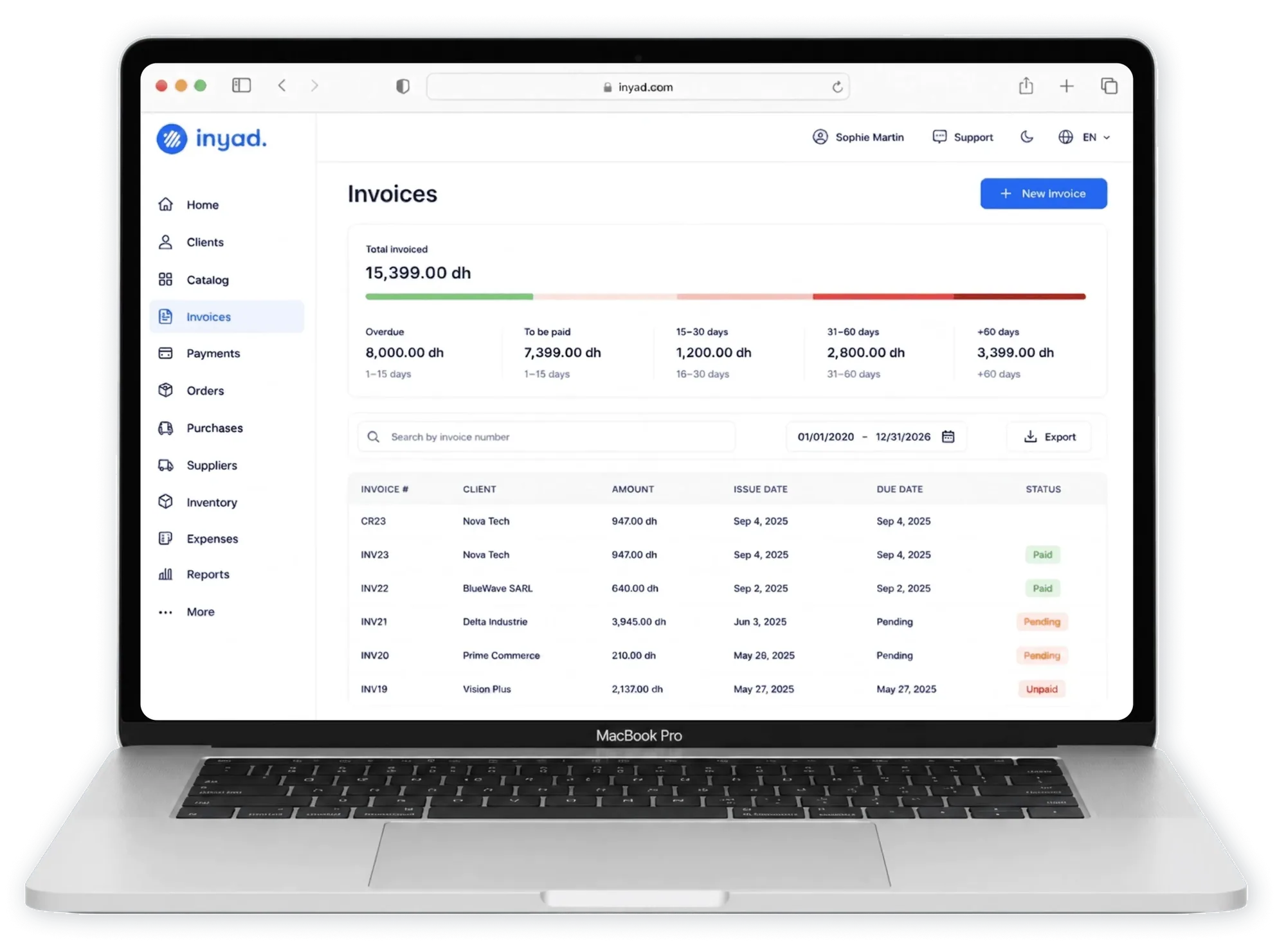
Record keeping and retention
Electronic invoices and electronic notes must be kept for at least 6 years, and they must be stored inside the Kingdom. Keep them in a form you can search and produce quickly: by invoice number, by customer, by date.
Retention is easier when your invoicing tool keeps the archive for you. The test is simple: if ZATCA asked for every invoice and credit note you issued to one customer in 2024, how long would it take you to send them? With a numbered digital archive, it is a search, not a week of digging through folders.
How to get ready for ZATCA e-invoicing
- Check your revenue against the thresholds. Add up your VAT-taxable revenue for each year from 2022 to 2025 and compare it with SAR 187,500, SAR 375,000 and SAR 750,000.
- Watch for ZATCA’s notification. Make sure the contact details on your ZATCA account are current so the notice reaches the right person.
- Review how you invoice today. List every place an invoice can be created: your counter, your sales team, your accountant. Each one must go through a compliant solution.
- Choose a solution that integrates with FATOORA. Ask the provider plainly whether it handles Phase 2 clearance and reporting, and how onboarding to FATOORA works.
- Clean your customer data. Business customers need correct names, addresses and VAT numbers on tax invoices. Fix them before your first cleared invoice, not after.
- Train the team on credit notes. Make sure nobody edits or deletes an issued invoice. Corrections always go through a note.
- Test before the deadline. Issue a few real invoices through the integrated solution weeks before your wave closes, so you discover problems while there is still time.
ZATCA e-invoicing with inyad Invoicing
inyad Invoicing integrates with ZATCA’s FATOORA platform for Phase 2 (integration). Your invoices go through the platform as part of the normal flow, so you keep invoicing as usual while the integration happens in the background.
Around it, inyad Invoicing handles the everyday work: you build a quote from your catalogue, turn it into an invoice in one click, number every document automatically, and raise a credit note against the original invoice when something changes. Every document is stored in one searchable archive, and you can send it to your customer on WhatsApp, by SMS or by email, with a payment link inside so they can pay from the invoice itself.
Recurring invoices for retainers and subscriptions go out on the schedule you set, and your reports show at a glance what is paid, pending and overdue.
Frequently asked questions
Is ZATCA e-invoicing mandatory for small businesses?
Phase 1 applies to every VAT-registered business, whatever its size. Phase 2 depends on your wave. As of October 2026, Wave 25 reaches businesses with more than SAR 187,500 of VAT-taxable revenue in any one year from 2022 to 2025, which includes many small businesses. Check your figures and your ZATCA notifications.
Can I keep issuing invoices from Excel or Word?
No. Since 4 December 2021, invoices must be generated by a compliant electronic solution. A spreadsheet or document template, even saved as a PDF, does not meet that requirement, and it cannot connect to FATOORA for Phase 2.
What happens if I make a mistake on an invoice?
You leave the original invoice as it is and issue an electronic credit note or debit note that references it. The note corrects the amount on record, and both documents stay in your archive for at least 6 years.
How do I know which Phase 2 wave applies to me?
Compare your VAT-taxable revenue with each wave’s threshold and watch for ZATCA’s advance notification, which is sent to businesses in each wave. If you are unsure, confirm with ZATCA or your tax adviser before the deadline rather than after.
Was this article helpful? Share on WhatsApp Send by email
Invoicing that keeps up with ZATCA
inyad Invoicing turns quotes into numbered invoices, raises credit notes, sends them on WhatsApp, SMS or email with a payment link, and integrates with ZATCA’s FATOORA platform for Phase 2.
The must-have criteria for FATOORA Phase 2, the features that save time every week, red flags, questions for vendors and a worked scoring.
8 min The FATOORA platform explained for Saudi businessesWhat FATOORA does, how clearance and reporting work in Phase 2, how a solution is onboarded, and the mistakes Saudi businesses make.
9 min Simplified tax invoice vs tax invoice in Saudi ArabiaWho each invoice is for, what it shows, clearance vs 24-hour reporting, input VAT, and worked examples in SAR at 15 % VAT.
8 min